Tag Archives: Theophilus Feutrill

NSW History Week – Day 4

Perspectives on a spearing

On 7 September 1790 (two hundred and thirty-two years and one day ago – I am posting this blog on 8 September 2022), on a beach in Manly Cove, the Governor of New South Wales, Arthur Phillip, was speared through the shoulder by a First Nations man. I had written a chapter for my book (‘More Than I Ever Had’) on this event, but as it didn’t make the final version I have uploaded it to my website as an additional chapter. Elizabeth Macarthur (the long suffering wife of John Macarthur), Lieut.-Gov David Collins, Lieut. Watkin Tench and a master’s mate from the Sirius, Mr Southwell, each provided their perspective on the incident in letters and journals. Following, is a compilation of their reports of events leading up to, during and after the incident.

Lieutenant Watkin Tench notes in his journal on 7 September, 1790:

WT “Captain Nepean, of the New South Wales corps, and Mr White[1], accompanied by little Nanbaree[2], and a party of men, went in a boat to Manly Cove, intending to land there, and walk on to Broken Bay. On drawing near the shore, a dead whale, in the most disgusting state of putrefaction, was seen lying on the beach, and at least two hundred Indians surrounding it, broiling the flesh on different fires, and feasting on it with the most extravagant marks of greediness and rapture. As the boat continued to approach, they were observed to fall into confusion and to pick up their spears; on which our people lay upon their oars: and Nanbaree stepping forward, harangued them for some time, assuring them that we were friends. Mr. White now called for Baneelon[3]; who, on hearing his name, came forth, and entered into conversation. He was greatly emaciated, and so far disfigured by a long beard, that our people not without difficulty recognized their old acquaintance. His answering in broken English, and inquiring for the governor, however, soon corrected their doubts. He seemed quite friendly. And soon after Colbee came up, pointing to his leg, to shew that he had freed himself from the fetter which was upon him, when he had escaped from us.

When Baneelon was told that the governor was not far off, he expressed great joy, and declared that he would immediately go in search of him; and if he found him not, would follow him to Sydney. ‘Have you brought any hatchets with you?’ cried he. Unluckily they had not any which they chose to spare; but two or three shirts, some handkerchiefs, knives, and other trifles, were given to them, and seemed to satisfy. Baneelon, willing to instruct his countrymen, tried to put on a shirt, but managed it so awkwardly, that a man of the name of M’Entire, the governor’s gamekeeper, was directed by Mr. White to assist him. This man, who was well known to him, he positively forbade to approach, eyeing him ferociously, and with every mark of horror and resentment. He was in consequence left to himself, and the conversation proceeded as before. The length of his beard seemed to annoy him much, and he expressed eager wishes to be shaved, asking repeatedly for a razor. A pair of scissors was given to him, and he shewed he had not forgotten how to use such an instrument, for he forthwith began to clip his hair with it.

During this time, the women and children, to the number of more than fifty, stood at a distance, and refused all invitations, which could be conveyed by signs and gestures, to approach nearer. ‘Which of them is your old favourite, Bar-an-gar-oo, of whom you used to speak so often?’ — ‘0h,’ said he, ‘she is become the wife of Colbee! but I have got Bul-la Mur-ee Dee-in [two large women] to compensate for her loss.’

September, 1790. It was observed that he had received two wounds, in addition to his former numerous ones, since he had left us; one of them from a spear, which had passed through the fleshy part of his arm; and the other displayed itself in a large scar above his left eye. They were both healed, and probably were acquired in the conflict wherein he had asserted his pretensions to the two ladies.

Nanbaree, all this while, though he continued to interrogate his countrymen, and to interpret on both sides, shewed little desire to return to their society, and stuck very close to his new friends. On being asked the cause of their present meeting, Baneelon pointed to the whale, which stunk immoderately; and Colbee made signals, that it was common among them to eat until the stomach was so overladen as to occasion sickness.

Their demand of hatchets being re-iterated, notwithstanding our refusal; they were asked why they had not brought with them some of their own? They excused themselves by saying, that on an occasion of the present sort, they always left them at home, and cut up the whale with the shell which is affixed to the end of the throwing stick.

Our party now thought it time to proceed on their original expedition, and having taken leave of their sable friends, rowed to some distance, where they landed, and set out for Broken Bay, ordering the coxswain of the boat, in which they had come down, to go immediately and acquaint the governor of all that had passed. When the natives saw that the boat was about to depart, they crowded around her, and brought down, by way of present, three or four great junks of the whale, and put them on board of her; the largest of which, Baneelon expressly requested might be offered, in his name, to the governor.”

Elizabeth Macarthur, recalled what she’d been told:

EM “On the 7th of Septr Captn Nepean, and several other Gentlemen went down the Harbour in a Boat; with an intention of proceeding to Broken Bay to take a view of the Hawkesbury River, in their way they put in at Manly Cove (a place so call’d from the Spirited behaviour of the Natives there at the Governors first landing). At this time, about two Hundred Natives were assembled, feeding on a Whale: that had been driven on Shore, as they discover’d no hostile intentions our party having Arms went up to them. Nanberry was in the Boat, and was desired to enquire for Bannylong[4], and Coleby when behold, both Gentlemen appear’d: and advancing with the utmost confidence ask’d in broken English, for all their old friends at Sydney. They exchanged several Weapons for provisions, and Clothes – and gave some Whale bone as a present for the Governor. Captn Nepean knowing this news would be very pleasing to the Govr. dispatch’d a Messenger to inform him of it, and proceeded on towards Broken Bay – The Govr. lost no time, but as soon as he was acquainted with the above circumstances order’d a Boat and accompanied by Mr Collins (The Judge Advocate) and a Lieut Waterhouse of the Navy; repair’d to Manly Cove, he landed by himself, unarm’d, in order to shew no Violence was intended.”

In David Collins’ account:

DC “Anxious to see him again, the Governor, after taking some arms from the party at the Look-out (which he thought the more requisite in this visit, as he heard that the cove was full of natives), went down and landed at the place where the whale was lying. There he not only saw Bennillong[5], but Cole-be also, who had made his escape from the Governor’s house a few days after his capture. At first his Excellency trusted himself alone with these people ; but the few months that Bennillong had been away had so altered his person, that the Governor, until joined by his companions[6], did not perfectly recoiled his old acquaintance. This native had been always much attached to Captain Collins, one of the gentlemen then with the Governor, and testified with much warmth his satisfaction at seeing him again. Several articles of wearing apparel were given to him and his companions (taken for that purpose from the people in the boat, but who, all but one man, remained on their oars to be ready in case of any accident) ; and a promise was exacted from his Excellency by Bennillong to return in two days with more, and also with some hatchets or tomahawks.”

EM “Bannylong approach’d, and shook hands with the Govr. – but Coleby had before left the Spot, no reason was ask’d why Bannylong had left[7] as he appear’d very happy, and thankful for what was given him; requesting a hatchet and some other things which the Govr. promised to bring him the next day, Mr. Collins, and Mr Waterhouse, now join’d them; and several Natives also came forward, they continued to converse with much seeming friendship untill they had insensibly wander’d some distance from the Boat and very imprudently none of the Gentlemen had the precaution to take a gun in their hand, This the Govr perceiving, deem’d it provident to retreat; and after assuring Bannylong that he would remember his promise; told him, he was going.”

WT “They[8] discoursed for some time, Baneelon expressing pleasure to see his old acquaintance, and inquiring by name for every person whom he could recollect at Sydney; and among others for a French cook, one of the governor’s servants, whom he had constantly made the butt of his ridicule, by mimicking his voice, gait, and other peculiarities, all of which he again went through with his wonted exactness and drollery. He asked also particularly for a lady from whom he had once ventured to snatch a kiss; and on being told that she was well, by way of proving that the token was fresh in his remembrance, he kissed lieutenant Waterhouse, and laughed aloud. On his wounds being noticed, he coldly said, that he had received them at Botany Bay, but went no farther into their history.

Hatchets still continued to be called for with redoubled eagerness, which rather suprized us, as formerly they had always been accepted with indifference. But Baneelon had probably demonstrated to them their superiority over those of their own manufacturing. To appease their importunity, the governor gave them a knife, some bread, pork, and other articles; and promised that in two days he would return hither, and bring with him hatchets to be distributed among them, which appeared to diffuse general satisfaction.

Baneelon’s love of wine has been mentioned; and the governor, to try whether it still subsisted, uncorked a bottle, and poured out a glass of it, which the other drank off with his former marks of relish and good humour, giving for a toast, as he had been taught, “the King.”

Our party now advanced from the beach; but perceiving many of the Indians filing off to the right and left, so as in some measure to surround them, they retreated gently to their old situation, which produced neither alarm or offence; the others by degrees also resumed their former position. A very fine barbed spear of uncommon size being seen by the governor, he asked for it. But Baneelon, instead of complying with the request, took it away, and laid it at some distance, and brought back a throwing-stick, which he presented to his excellency.”

EM “…at that moment an old looking Man advanced, whom Bannylong said was his friend, and wish’d the Govr. to take notice of him, at this he approach’d the old Man, with his hand extended…”

WT “Matters had proceeded in this friendly train for more than half an hour, when a native, with a spear in his hand, came forward, and stopped at the distance of between twenty and thirty yards from the place where the governor, Mr. Collins, lieutenant Waterhouse, and a seaman stood. His excellency held out his hand, and called to him, advancing towards him at the same time, Mr. Collins following close behind. He appeared to be a man of middle age, short of stature, sturdy, and well set, seemingly a stranger, and but little acquainted with Baneelon and Colbee. The nearer, the governor approached, the greater became the terror and agitation of the Indian…”

EM “when on a Sudden the Savage started back and snatch’d up a spear from the ground, and poiz’d it to throw the Govr seeing the danger told him in their Tongue that it was bad; and still advanced: when with a Mixture of horror, and intrepidity, the Native discharg’d the Spear with all his force at the Govr, it enter’d above his Collar bone, and came out at his back nine inches from the entrance; taking an Oblique direction…”

DC “..but Bennillong, who had presented to him several natives by name, pointed out one, whom the Governor, thinking to take particular notice of, stepped forward to meet, holding out both his hands towards him; The savage not understanding this civility, and perhaps thinking that he was going to seize him as a prisoner, lifted a spear from the grass with his foot, and, fixing it on his throwing-flick, in an instant darted it at the Governor. The spear entered a little above the collar-bone, and had been discharged with such force that the barb of it came through on the other side.”

EM “the Natives from the Rocks now pour’d in their Spears in abundance; so that it was with the utmost difficulty, and the greatest good fortune: that no other hurt was rec’d in getting the Govr into the Boat.”

WT “Instant confusion on both sides took place; Baneelon and Colbee disappeared; and several spears were thrown from different quarters, though without effect. Our party retreated as fast as they could, calling to those who were left in the boat, to hasten up with fire- arms. A situation more distressing than that of the governor, during the time that this lasted, cannot readily be conceived:-the pole of the spear, not less than ten feet in length, sticking out before him, and impeding his flight, the butt frequently striking the ground, and lacerating the wound. In vain did Mr. Waterhouse try to break it; and the barb, which appeared on the other side, forbade extraction, until that could be performed. At length it was broken, and his excellency reached the boat, by which time the seamen with the musquets had got up, and were endeavouring to fire them, but one only would go off, and there is no room to believe that it was attended with any execution.”

EM “As soon as they return’d to this place[9], you may believe an universal solicitude prevail’d as the danger of the Wound could by no means be asertain’d, untill the spear was extracted and this was not done before his Excellency had caus’d some papers to be arranged – lest the consequence might prove fatal, which happily it did not, for in drawing out the spear, it was found that as no vital part had been touch’d. the Governour having a good habit of Bodily health – the wound perfectly heal’d in the course of a few weeks.”

WT (Regarding the party that had gone on to Broken Bay) “On reaching Manly Cove, three Indians were observed standing on a rock, with whom they entered into conversation. The Indians informed them, that the man who had wounded the governor, belonged to a tribe residing at Broken Bay, and they seemed highly to condemn what he had done. Our gentlemen asked them for a spear, which they immediately gave. The boat’s crew said that Baneelon and Colbee had just departed, after a friendly intercourse: like the others, they had pretended highly to disapprove the conduct of the man who had thrown the spear, vowing to execute vengeance upon him.

From this time, until the 14th, no communication passed between the natives and us. On that day, the chaplain and lieutenant Dawes, having Abaroo with them in a boat, learned from two Indians that Wil-ee-ma-rin was the name of the person who had wounded the governor. These two people inquired kindly how his excellency did, and seemed pleased to hear that he was likely to recover. They said that they were inhabitants of Rose Hill, and expressed great dissatisfaction at the number of white men who had settled in their former territories. In consequence of which declaration, the detachment at that post was reinforced on the following day.”

And, finally, an extract of a letter to home from a youngster named Southwell, a master’s mate on the Sirius:

“I cannot sufficiently express my approbation of your good sense in forbidding those who perused it to publish my insignificant narrative; or my chagrin at their improper conduct who have, notwithstanding, taken the liberty to do so. I saw it, being the concluding part, in the Hampshire Chronicle and Portsmouth and Chichester Journal, Sept’r 7, 1789. Mr Morgan, since we were at sea, came across it, and from peculiarity of stile immediately recognized it, as did most of our principals on board. I add that I am vexed at it for several reasons, and pray you to take care who you honour with a sight of my cobweb productions, if this is the way they honour them. Apropos, that date is the anniversary of the Governor’s misfortune of the year 1790, when he was speared by a native in Manly Bay, in a manner which savours much of imprudence next to folly. Bennilong, as I said in my letters, had made his escape, and this was the first interview since that incident. It, however very near fatal, proved by no means so, as he soon recovered, and it was followed by the fullest intercourse with these people, insomuch that they eat, drink and sleep in the camp with the most perfect sangfroid; and some of their dames, like too many of ours, gladly forego that dear pleasure of nursing their own bratts, and leave them in perfect security to the care of several of the convict women, who are suitably rewarded by the Governor.”

**

Historians have conjectured whether the governor was lured to Manly Cove for the very purpose of spearing him, as a payback for his capture and detention of Benelong and Colebee: the governor had to ‘pay’ for this injustice in order for the First Nations people to forgive him. But then again, it could just have been a case that the person who speared the governor was alarmed from the governor’s actions.

From Watkin Tench: “…the nearer, the governor approached, the greater became the terror and agitation of the Indian. To remove his fear, governor Phillip threw down a dirk, which he wore at his side. The other, alarmed at the rattle of the dirk, and probably misconstruing the action, instantly fixed his lance in his throwing-stick.”

In any respect, relations with Benelong and other First Nations people became cordial again following the spearing.

**

‘More Than I Ever Had’ is based on the true story of Theophilus Feutrill who enlisted in the NSW Corps in 1789 in Birmingham. The book is available from independent booksellers in Sydney and from Amazon.


[1] Surgeon John White

[2] Nanbree or Nanbarry, nephew of the Cadigal leader Colebee, was brought into the Sydney settlement in April 1789, seriously ill from smallpox, which had killed his mother and father. He recovered after treatment by Surgeon John White, who adopted him.

[3] Also known as Benelong

[4] Also known as Benelong

[5] Also known as Benelong

[6] The governor was accompanied by David Collins and Lieutenant Waterhouse.

[7] Assume Mrs Macarthur is referring to why Benelong and Colebee escaped from their capture by the governor.

[8] Governor Phillip, Benelong and Colebee

[9] Back to the governor’s home

NSW History Week – Day 3

Military mayhem in 1796

In support of NSW History Week 2022, here is the third of five stories that formed the basis of my research for my novel More Than I Ever Had. This book is based on the true story of Theophilus Feutrill, who enlisted in the New South Wales Corps in 1789 in Birmingham.

In February 1796, Theophilus Feutrill was one of four people whose name was on an arrest warrant issued by the Governor of New South Wales, John Hunter. If found guilty of the charges, the men named would be “obliged to answer for it, most probably with their lives.”

What were the circumstances that lead to this arrest warrant being issued? And, could Theo Feutrill, and the three other privates whose names were on the arrest warrants, really be the masterminds behind what happened, or where they just the scapegoats?

When John Hunter took over as Governor of New South Wales in September 1795, he knew he had a tough job ahead of him. The settlement was largely dependent on rum as currency and much at the mercy of the monopolistic trading practices of the military hierarchy and other officials. He complained in harsh terms to the Duke of Portland (one of the three Secretaries of State, who Hunter reported to) about the quality of the military members:

“…I should feel myself deficient in that duty which I owe to his Majesty’s service in this part of the world were I not to take a liberty which I have no reason to believe your Grace will be offended at—I mean, in remarking that the manner in which this corps has, since employed upon this service, been recruited does in a great measure weaken the effect or service which we would expect to derive from the assistance of the military. Soldiers from the Savoy,* and other characters who have been considered as disgraceful to every other regiment in his Majesty’s service, have been thought fit and proper recruits for the New South Wales Corps, which, in my humble opinion, my Lord, should have been composed of the very best and most orderly dispositions. They are sent here to guard and to keep in obedience to the laws, when force may be requisite, a set of the worst, the most atrocious characters that ever disgraced human nature; and yet we find amongst those safeguards men capable of corrupting the heart of the best disposed, and often superior in every species of infamy to the most expert in wickedness amongst the convicts. Our stores, provisions, and granaries must be intrusted (sic) to the care of those men: what security can we have in the hands of such people?”

*The Savoy was the name of the prison which housed military offenders.

At the time, Governor Hunter was approaching the age of sixty. Those who supported him were significantly younger: Captain Paterson, the commander of the Corps was forty; Captain John Macarthur, Inspector of Public Works, was twenty-eight. No others were older than Paterson. In the absence of a free press where independent commentary might have reached those back in London, the Duke of Portland relied not only on dispatches from Hunter, but he was also being petitioned by the likes of the ambitious John Macarthur, who held little back in his criticisms of the administration.

Governor Hunter’s leadership was tested following an event which occurred on 5 February 1796, and is considered to be the catalyst for the Duke of Portland to eventually recall him to England and replace him as Governor. In a letter from Governor Hunter to the Duke of Portland dated 10 August 1796 (which was not acknowledged by Portland until more than a year later on 31 August 1797), Hunter outlines an event which he describes as an ‘outrage’. An abridged version of his report is below:

“Statement of the Case of John Baughan.

John Baughan…foreman of the carpenters working at Sydney, and a private soldier of the New South Wales Corps, (also a carpenter), had some dispute when formerly working together… This dispute, it appeared, had not subsided in the min of the soldier, and was probably not wholly forgot by the other.

…One day when sentinel over a storehouse, knowing that Baughan was at work in a house some distance from his post, (the Private) set his arms down against the wall of the store, and seeing a man whom he knew standing on the outside of the building in which Baughan was at work, entered into a conversation with him, of which Baughan was the subject, and which much abuse was bestowed, (and)… meant for Baughan (to) (over)hear.

Baughan went out at the back door unperceived, and seeing the soldier without his arms, went to his post, where he found the musquet, which he took up and carried to the guard-house, and delivered to the Serjeant (sic) of the guard. The soldier was, of course, taken notice of and relieved, being without his arms.

The next day, 5th February, at half-past nine o’clock in the forenoon, the whole of the corps off duty at this place assembled, and in the most public and tumultuous manner proceeded to the dwelling of John Baughan, broke open his gates, doors, and windows, entered his house, chopped the corner-posts of it, broke his bedsteads and bedding, chairs, window-frames, drawers, chests, and, in short, completely demolished everything within his possession to a considerable amount, for the man had, by great labour and industry, built himself a neat house, and had it well furnished.

Upon their first approach, having had a few minutes’ notice, he armed himself with a loaded gun and defended himself by threats for some time, but their numbers were so many that they surrounded his paling which inclosed (sic) the house, which some tore down and entered on the opposite side to that which he endeavoured to defend, came behind him, secured and threw him down, with his face to the ground, whilst one held an axe over his neck, and swore if he offered to stir he would chop the head from his body. During the time he remained in this situation they completed the ruin of his whole property, to the very great terror of the man’s wife, after which they went off cheering, as if something meritorious had been effected, and marched in a body cross the parade before their commanding officer’s house.

After so daring an attack, in the open day, upon the dwelling-house of an inhabitant, and in direct defiance of all law, civil or military, they could only be considered as in a state of mutiny. I immediately issued in Public Orders the paper No. 2.”

Public Orders Paper #2 is reproduced below:

Government and General Order.  5th February, 1796.

“The very riotous manner in which the soldiers have conducted themselves this morning, and the very unwarrantable liberty they have thought proper to take in destroying the dwelling-house of John Baughan, is so flagrant a crime against the laws established in this colony that nothing but the want of proof to substantiate who the principal actors in this disgraceful business were could possibly prevent their being immediately tried for so glaring an offence against the peace of the colony.

The Governor thinks it necessary to assure the soldiers that he considers their conduct upon this occasion to have been disgraceful to the character of a British soldier, and that he did hope to have found men amongst them who would have had pride enough to have stood forward and pointed out the ringleaders of so mutinous a conduct, for in no other light can it be considered than that of mutiny when the military assemble in such numbers unknown to their officers, who are at all times ready to listen to any complaints they may have to make, and to see that agreeable to common justice they are redressed. If the soldiers expect that the Governor or any of the officers in this settlement can hereafter consider them as…meriting the honorable appellation of British troops, it must be by their bringing forward the ringleaders or advisers of this disgraceful conduct, in order that the stigma may be wiped away by such worthless characters being brought to trial for this shameful conduct.”

The reception of the Public Orders and mood of the soldiers is indicated by Governor Hunter in his letter to the Duke of Portland:

“But as an alteration in the ration had at that very time been ordered, I think it necessary to observe that their temper at the moment was so violent that they positively refused to take it unless they were served all flour, instead of part flour and part corn, a desire which could not be complied with without manifest injustice to others, and also insisted upon being paid short-allowance money for the time they were on short ration, which they say Governor Phillip had promised them. This last demand I must request your Grace’s instructions upon.”

Governor Hunter met with the commander of the Corps, Captain William Paterson on 6 February and wrote to him the next day advising his change of heart (wisely) in wanting to address the soldiers directly. He couched his decision that to address them directly “would be a condescention on my part which their violent and unsoldierlike conduct does not entitle them to from me.” He goes on to say to Paterson: 

“I must declare to you, sir, that the conduct of this part of the New South Wales Corps has been,…the most violent and outrageous that was ever heard of by any British regiment whatever, and I shall consider every step they may go father in aggravation as rebellion against his Majesty’s government and authority, of which the most early notice shall be taken, and those concerned be in due time obliged to answer for it, probably with their lives.”

As previously mentioned, the Duke of Portland did not respond to Governor Hunter on this matter for more than a year, leaving the governor to deal with this without his support. The governor did, however, have the support of Doctor William Balmain who (without legal training) held the position of Judge-Advocate. From the military side, Captain John Macarthur represented the interests of the NSW Corps.

After the attack on his home, John Baughan, fearing further retribution, declined to identify those involved or to pursue the matter. Dr Balmain ‘proffered’ legal advice (some historians considered Balmain threatened Baughan with obstruction of justice should he not progress the matter ). After some days, four names were eventually given up. When the governor issued the arrest warrants, the military was further enraged at Balmain’s “shamefully malevolent interference in the affairs of the Corps”. One of the warrants was for the arrest of Theophilus Feutrill.

As the military were responsible for enacting the arrest warrants, Captain John Macarthur approached the governor and stalled the process. Thus began a test of strength between the civil and military authorities. As Theophilus fretted over his fate—he was facing potential execution if found guilty—a series of letters was exchanged between Judge Advocate Balmain (representing the civil authority) and Captain John Macarthur (representing the military). Tempers frayed and insults given to the point that Balmain told Macarthur he was “a base rascal and an atrocious liar and villain”. Balmain then challenged Macarthur to a duel, which was subsequently withdrawn.

Captain Macarthur approached the Governor in the name of the Corps and was “expressive of their contrition, their sincere concern for what had happened, promising at the same time that they would endeavour by their future conduct to wipe away the odium which this recent instance of disorder and want of respect for the laws, the peace, and order of the settlement had brought upon them; they also agreed to indemnify the sufferer for his loss.” Upon receiving this message from Macarthur, and by the personal petition of the sufferer, John Baughan, the governor ordered the warrants to be withdrawn as “the consequences would otherwise most probably have been fatal to some.”

Peace was restored, but the Duke of Portland saw Hunter’s capitulation as weakness in his leadership.

John Hunter was recalled to London in a stern dispatch from Portland dated 5 November 1799. The withdrawal was acknowledged by Hunter on 20 April 1800, and he handed over the government to Lieutenant-Governor King on 28 September.

Why was Theophilus Feutrill’s name included on the arrest warrant? The Governor wanted the members of the military to come forward and give up the names of the ring leaders. But it appears unlikely that a private soldier would have the compelling presence or authority to whip up “all off-duty military members” to such an action. Was he, and the other privates listed just scapegoats, or were they more involved? The records are silent, but it is easy to imagine the relief he and his wife Ann would have felt upon hearing the warrants were withdrawn.

**

‘More Than I Ever Had’, based on the true story of Theophilus Feutrill, is available from independent booksellers in Sydney and Amazon.

NSW History Week – Day 2 part III

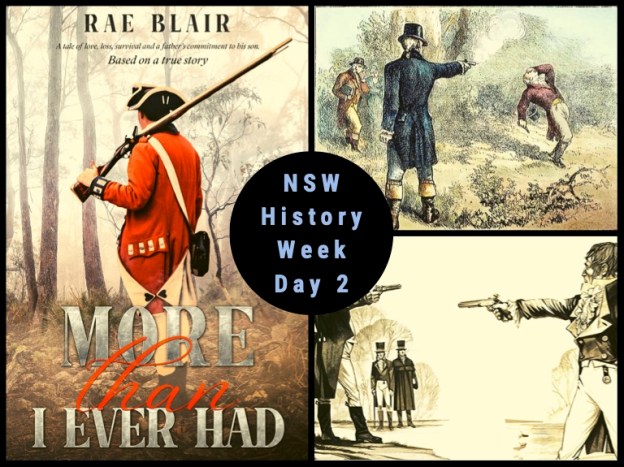
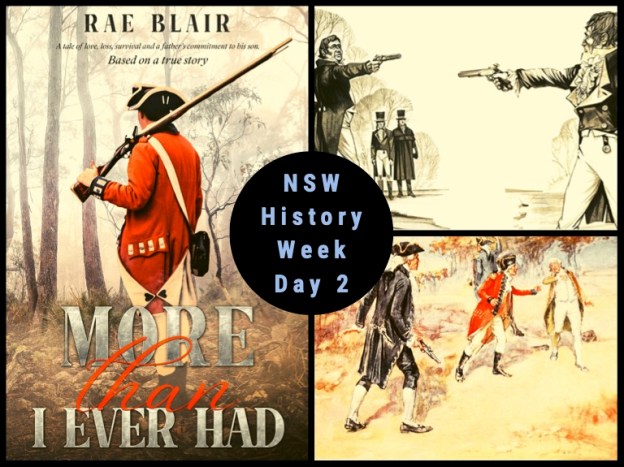
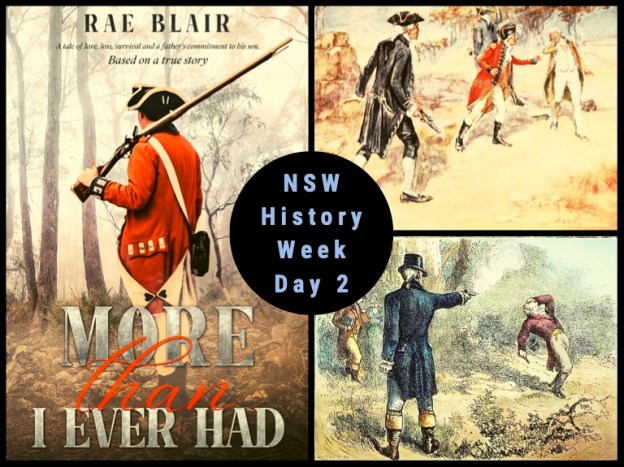
Duelling personalities: Part III

In support of NSW History Week 2022, here is part III of the second of five stories (presented in three parts) that formed the basis of my research for my novel More Than I Ever Had. This book is based on the true story of Theophilus Feutrill, who enlisted in the New South Wales Corps in 1789 in Birmingham.

Duel number three: Paterson v Macarthur 1801. Petty grievances

An article published in the Australian Star in September 1896, recounts a long-winded story about Sydney’s “first duel”*. It says “The whole affair is contained in the correspondence, official and private, and the tediousness is entirely due to the childish tetchiness, the elaborate slyness and the queer prolixity of many of the persons concerned. These were almost every individual of any station in the little community in the year 1801 of the occurrence.”

I’ll boil down the story as much as I can, but the whole issue begins with a drowning enroute to New South Wales. The drowned man’s effects were taken by the naval agent, Lieutenant Marshall, who replaced them with inferior products. Lieutenant John Macarthur—who was the temporary officer commanding the New South Wales Corps, in the absence of Colonel William Paterson—became aware of the swindle and took the matter up. The Governor severely reprimanded Lieutenant Marshall and sent him back to England on the next whaler. The article writes: “Marshall, resenting Macarthur’s action in the matter, thereupon found means to insult Captain Macarthur, who promptly sent Captain Abbott, of his corps, with a challenge. Lieutenant Marshall accepted.”

The problem was that Lieut. Marshall named a Mr Jefferies (purser of the Cornwallis) as his second. Macarthur was “up to his eyes in trade in spirits and every other commodity” so he ‘loftily objected’ and he would “by no means recognise (Jefferies) as second to his adversary.” Marshall duly attended the duel at the specified time and place, but Macarthur kept away. Enraged, Marshall “provided himself with a cudgel and went in search of (Macarthur).” Marshall found Captain Abbott in the doorway to Macarthur’s office, and he “dealt Captain Abbott a lusty thump on the ribs” then went in pursuit of Macarthur. When approached, Macarthur “(drew) his sword, (and) threatened to run the angry lieutenant through the body.” Marshall was arrested and taken to the guard-house.

Governor King then ordered that Lieut. Marshall should be tried by criminal court for assault against Abbott and Macarthur. By this time, Colonel Paterson had returned and “the court was property constituted with him, four other officers of the NSW Corps, Lieut. Grant and the Judge Advocate.” Whilst the case against Marshall for his “shady transaction with respect to the personal effects of the (drowned person)”, was straightforward, “Macarthur’s refusal to meet Lieut. Marshall in a duel appears to have been…impertinent, inasmuch as according to Governor King, he subsequently entertained at dinner at his own house, in company with Captain Abbott, the very man on whose selection as second to Lieutenant Marshall he alleged his disinclination to appear in the field.” Marshall “took objection to the constitution of the court” being made up of NSW Corpsmen, which was denied. Whilst Governor King did not intervene during the trial (Marshall was found guilty and sentenced to 12 months prison), he was provided with a record of the proceedings where there was “little doubt that the proceedings were conducted with distinct animus against the prisoner.” The Governor considered the appeal of the prisoner rested “on grounds solid enough to require serious attention. He instructed the court reconvene to investigate the allegations “not only to defend its own integrity, but to afford the most unequivocal justice to the prisoner…” The members of the court met, but refused to comply and “immediately dispersed.” The Governor said that he would “bring the business under the notice of the Secretary of State, and ask for support of his authority.” The five military members of the court wrote a letter asking for a copy of Marshall’s protest. The Governor refused, as the five military members were only a part of the seven member court. This pitted the five military members against the two others, and the officers “got savage and rather desperate. They agreed amongst themselves to cut the Governor socially. But this course proved too compromising (for) Colonel Paterson (who) quietly seceded. He resumed his ordinary relations with the Governor. Macarthur was furious.”

And this is where things become petty and dangerous.

Macarthur “threw the obligations of military discipline to the winds. He cast aside the obligations of a gentleman. He divulged private conversations with the colonel, he disclosed confidential communications. He stooped so low as to exhibit a private and familiar letter from Mrs Paterson to Mrs Macarthur. The fact was that the colonel had not been at all guarded in his demeanour and acts with relation to the Governor. He had criticised. He had sneered. He had even …(written)…to Sir Joseph Banks and General Brownrigg attacking the Governor’s public character and transactions. Macarthur had participated in these indiscretions. There are indications that he had instigated them. He now threw the burden of them on his colonel.” Colonel Paterson responded by doubling-down on his relationship with the Governor, and sent Macarthur a challenge.

The duel took place—Colonel Paterson chose Captain McKellar as his second, Macarthur chose Captain Piper. A scandal occurred when contrary to “all the proprieties” Macarthur was permitted to load his own pistols, rather than his second, which was the proper course of action. Macarthur asserted “there was something the matter with the locks (on his) pistols (and) it wasn’t safe for anyone unacquainted with their peculiarities to wad them…” Captain Piper, Macarthur’s second, won the toss for first shot.

The combatants stood at a distance and side-on, to make themselves as small a target as possible. Macarthur had first shot and “it took effect in the Colonel’s right shoulder. He was disabled and could not return the fire. A week later, his life was not out of danger. The Governor, of course, heard of the affair” and arrest warrants were issued to all those involved (except for the wounded man, Colonel Paterson).

The pettiness continued.

The Governor ordered Macarthur to Norfolk Island, but Macarthur refused to be released from prison. He demanded “reasons for being put under arrest…and for being ordered out of arrest.” Correspondence “hailed on everybody and from everybody, and a regular devil’s brew of cavils, assertions and explanations bubbled in a joint stock pot. Surgeons, adjutants, chaplain, judge advocate, surveyor, ensigns, lieutenants, captains, all had a finger in the mess. The Governor, while yet the pot was in full boil, got rid of Lieutenant Marshall…(by) shipping him off to be dealt with in England. As Macarthur positively would not be ordered out of arrest, he was got rid of in the same fashion, fighting tooth and nail to the last hour, and very nearly managing to bring about a small insurrection by treating his detachment of New South Wales Corps to a dinner and grog, such grog being removed from store without a permit, intercepted and seized by the officer of the guard, and all but violently rescued by the soldiery for whose benefit it had been intended.”

Whilst Macarthur was shipped off to England, he returned and was embroiled in the Rum Rebellion of 1808, but that, of course, is another story 😊

**

‘More Than I Ever Had’ based on the true story of Theophilus Feutrill is available from independent booksellers in Sydney and from Amazon. Link to Amazon Australia site here.

NSW History Week – Day 2 – Part II

Duelling personalities: Part II

In support of NSW History Week 2022, here is part II of the second of five stories (presented in three parts) that formed the basis of my research for my novel More Than I Ever Had. This book is based on the true story of Theophilus Feutrill, who enlisted in the New South Wales Corps in 1789 in Birmingham.

Duel number two. Ross v Hill 1791. A fight for justice

Whilst this duel was fought in Sydney in December 1791, the fuse was lit in Norfolk Island. But, first, you need a bit of background on the combatants. Major Robert Ross was appointed lieutenant-governor of New South Wales in 1786 and he arrived in Sydney Cove with the First Fleet in January 1788. At the time Major Ross was the commander of the New South Marines and he had very firm views as to the establishment of the settlement—often at odds with those of Governor Phillip. Phillip endured this for over two years, but in March 1790, he saw an opportunity to remove the key source of friction from Sydney Cove, and sent Ross to take charge of Norfolk Island. Whilst this finally gave Phillip some breathing space, the British government had already decided to recall the fractious Major Ross and his New South Wales Marines, and a replacement military presence was already on its way—the New South Wales Corps—which included Private Theophilus Feutrill as part of the Second Fleet.

Now, over 1,000 miles away from Sydney Cove, Major Robert Ross was finally free to show everyone how a settlement ought to be developed. But, after the Sirius was dashed on the rocks, Ross declared martial law on the island, and removed the convicts from the government’s food stores—instead they had to grow their own food in the limited time available to them. Ross requested extra resources come to the island to ramp up development, and Captain William Hill was instructed to take a detachment of twenty-six men with him to Norfolk Island—and that included Theo Feutrill.

Once there, Captain William Hill clashed constantly with Major Ross, about the brutality of his punishments and his inhumane policies (all of which were abolished by Ross’s successor). He wrote numerous reports back to Governor Phillip. When Captain Hill and his men’s tenure was over at Norfolk Island, a replacement detachment arrived, but also onboard was a replacement for Major Ross as commandant of the Island. Captain Hill and his men boarded the Queen, as did Major Robert Ross and his second-in-command Ralph Clark (Quartermaster General and Keeper of the Stores). Whilst they awaited favourable winds to take them back to Sydney, Captain William Hill seized an opportunity to call Major Ross to account. Ralph Clark’s journal tells his side of the story:

“Wednesday, 16 November 1791

Captain Hill taken an unfair advantage of Major Ross by examining Convicts on Oath before the Revd. Mr. Johnstone and Mr. Balmain who are prejudice like himself against Major Ross fore these Said Convicts there are not greater rascals under heaven than they are and would Sell there fathers life if the[y] could get any thing by it.

Thursday 17th

The Queen in the Bay ——In her was Examined on Oath by Major Ross before Mr. Johnson and Balmain respecting a message which Mr. Hume Superintendant of the Convicts brought some time back to Major Ross from Chas. Gray Convict, which message he, Mr. Hume, said Major Ross forced him to Sign and Swear contrary to his inclination and wish, and that Mr. Faddy, Sergeant Kennedy and myself were present when he was forced ,which he informed Captain Hill and Swore Yesterday in Court —— also that he was forced when Faddy, Sergeant Kennedy and myself declared on Oath that he was not forced but on the Contrary was desired by Major Ross and myself repeatedly not to Sign or Swear to it if he did not like it or if there was any thing in it which was not as he had Related to Major Ross in the presence of Faddy and my Self —— he made answer to that there was not any thing contained but what he had Related and was perfectly Save in Signing it —— what a Rascal this Hume is.”

At this inquiry, Captain Hill had in his possession a report which was signed by a convict, Charles Gray. Gray declared under oath that Ross forced him to sign and swear the accuracy of the details in this report, which was contrary to his inclination and wish. Gray testified he was allocated to work at Queensborough, formerly known as Charlotte Field, and that he and many others made representation to (convict overseer) Mr Hume that they were not able to keep up, what they describe as ‘an impossible and punishing’ workload – a workload which had been set by Lieutenant Clark in his ambitions to complete the construction of the village.

Gray believed that word got back to Lieutenant Clark about what was said to Mr Hume, and that the Lieutenant ordered for his rations to be withheld, in punishment. But, not only his rations, but also the rations of his fellow workers, Thomas Strich and William Jones. Gray, Strich and Jones believed with no food they had no option but to leave the area to hunt for food for themselves.

Gray and Jones returned the same night, but Thomas Strich remained absent. Gray became a targeted man. On 23 May, a convict called James Thompson was cutting down a pine tree, when it fell onto him and broke his leg. Mr Gray and another convict, Michael Dennison, who were working nearby, attended to Mr Thompson, and carried him to the hospital for treatment. Lieutenant Clark punished Gray and Dennison’s absence with 200 lashes for Mr Gray and 25 for Mr Dennison. Then, on a further occasion, in October, Mr Gray received another 100 lashes for disobedience of orders and neglect of duty. It was at this point that Mr Gray lodged a formal complaint against Lieutenant Clark to Mr Hume—the basis of which that he had been singled out for special attention and unfairly punished.

Thomas Strich decided to return in June 1791. The reason for not punishing Strich upon his return was that Major Ross considered that the trouble and hardship Strich must have suffered in mind and body from the weather when he was away, and want of clothes, was a sufficient punishment for him in running away. Major Ross had forgiven him his crimes. At the inquiry, Captain Hill suggested that Major Ross struck a deal with Strich, that he would be saved the lash, if he informed on his fellow convicts.

Captain Hill suggested that when Mr Hume came to Major Ross with the formal complaint from Charles Gray, Ross called Gray to his office. As Gray could not read or write, Ross called Lieutenant Clark into his office, and Ross dictated Gray’s complaint for Clark to write down. Although, what Ross had Clark write down, put a different view on the complaint, and put both Ross and Lieutenant Clark in a more favourable light. Gray was then forced to swear to the accuracy of the report and sign it.

Clark said that he and Major Ross told Gray not to sign or swear to the report if he did not like what was said, or if there was anything in it which was not as he had related to Major Ross. Before Gray signed the report, Ross also called Lieutenant William Faddy into the room—a lieutenant with a reputation that the convicts fear. Gray felt he had no option but to sign the document Ross and Clark had constructed.

Ross was furious with Captain Hill’s interference, and saw it as an attempt to besmirch his reputation. He challenged Hill to a duel upon their return to Sydney Cove. Captain Hill received a message on 11 December 1791 which read:

0600 tmrw. Field nth of Marine Camp. Bring a 2nd. signed by Major R. Ross.

Following is a deleted scene of the duel from More Than I Ever Had, which I couldn’t fit into the printed version:

On 12 December 1791, Major Robert Ross and Captain William Hill—accompanied by their seconds and an impartial observer—gathered in the field just north of the Marine Camp at 6:00 am. Theo and James Bannister stood in amongst the other onlookers. Theo hadn’t slept, tossing in his cot with worry for his captain. William Douglas joined them, hair askew from his pillow.

The crowd shared low, expectant chatter as to the outcome. The air was still, and the odour of the men mixed with the fresh eucalypt from the bush. Grass crunched under foot, bone dry from lack of rain. The sun had already risen in a clear blue sky, and the trees were alive with birds busy finding their breakfasts. A kookaburra laughed.

Captain Hill and his second stood apart from the onlookers. If the captain was nervous, he didn’t show it. His second wiped down the pistol and checked it again.

Standing with his second, at the opposite end of the field to Captain Hill, Major Ross took a swig from a hip flask. The major’s second had his head bent over the task of preparing the pistol; the process more elaborate than the preparation undertaken for Captain Hill’s. Theo chewed his lip, and despite the early morning being warm, he shivered.

The seconds had already measured and marked out the ground showing at which point Ross and Hill would stand—at a distance opposite and facing each other. Ross and Hill checked their pistols, walked to their appointed places and waited. Their eyes locked on each other. Arms by their sides. Whilst Hill appeared calm but determined, Ross’s face coloured with hatred. Theo wanted to look away.

The independent observer held aloft a handkerchief for a moment before it fluttered from his grip. At this signal, Ross and Hill raised their pistols and stepped toward each other.

Theo’s fingernails dug into his palms.

Ross fired first. A misfire! Theo flinched at the dull click. His eyes darted from Ross to Hill, flooded with relief the captain was spared. Hill moved his aim left of Major Ross and fired. Surprised murmurs came from the crowd. Many disappointed to be denied the blood they’d hoped to see, but for Theo he couldn’t be happier.

Major Ross, his face now drained white, recovered his composure and drew himself to full height.

“I am satisfied,” he said, before striding off with his second in close pursuit.

**

‘More Than I Ever Had’ based on the true story of Theophilus Feutrill is available from independent booksellers in Sydney and from Amazon. Link to Amazon Australia site here.

NSW History Week – Day 2

Duelling personalities: Part I

In support of NSW History Week 2022, here is the second of five stories (presented in three parts) that formed the basis of my research for my novel More Than I Ever Had. This book is based on the true story of Theophilus Feutrill, who enlisted in the New South Wales Corps in 1789 in Birmingham.

In eighteenth century England, duelling—that is an arranged shooting between two people for the sake of honour—was against the law, and to kill in the course of a duel was judged as murder. However, it was widely practiced by the male members of ‘nobility’ and the upper classes where one’s honour needed to be restored. The conduct of a duel is at the combatant’s discretion and mutal agreement—they could stand back to back and walk ten paces and turn and shoot; they could start at opposite ends of a clearing and walk towards each other with pistols held in arms outstretched and shoot, or they could stand at a prescribed distance and toss for who gets to shoot first. A constant requirement is that the combatants must have seconds, whose job it is to load the pistols, and confer with each other as representatives of the combatants. A neutral person makes a signal for the duel to commence.

In Bilston, the west-midlands of England, where Theo was raised in the mining and manufacturing community, he would not have witnessed any duels. But he didn’t have to wait long after he boarded the Neptune to watch his first. In fact, the Neptune hadn’t even left English waters before tempers spilled over and someone’s ‘honour’ needed to be restored. And, there were at least two more held in Sydney in the very early days of settlement, one involving the ambitious and fiery John Macarthur (he was also involved in the first one), and one involving Theo’s captain, Captain William Hill.

Duel number one: Macarthur v Gilbert 1789. Tempers on board

Ambitious and newly promoted, Lieutenant John Macarthur boarded the Neptune, with his wife and young son, to sail to New South Wales as part of the NSW Corps. As the ship pulled away from Woolwich Wharf, he, and other members of the military, soon realised they had no status on the ship, being under the complete control of the ship’s captain, Captain Thomas Gilbert, and his crew. And, worse, Captain Gilbert and his crew had little regard for the comfort and welfare of the passengers. Macarthur’s bitter complaints to the captain about the quarters provided to him and his family were disregarded, which led to a blazing confrontation. The Sydney Morning Herald published an article, in February 1945, which recounted the following story:

“The casus belli between Macarthur and John (sic) Gilbert, the captain of the ship, arose from the former’s complaints regarding the location and fittings of his cabin, and ‘the stench of the buckets belonging to the convict women of a’morning.’ Gilbert threatened to write to the War Office and have Macarthur and his wife turned out of the ship. Gilbert gave Macarthur a punch on the breast. Nepean interfered and patched up the quarrel temporarily…..On the seven days trip round to Plymouth there was another flare-up, Macarthur accusing the captain of ungentlemanly conduct towards himself and his wife, and calling him publicly on the quarter-deck—he had a fine capacity for vituperation—‘a great scoundrel’. In retaliation, Gilbert told Macarthur that he had ‘settled many a greater man than him’, and that he was to be seen on shore, whereupon Macarthur named 4 o’clock at the Fountain Tavern, Plymouth Docks. They met, a duel was fought—apparently a bloodless one—honour was satisfied and both parties agreed to live in harmony thereafter.”

Theo and his brother soldiers would have gathered nearby to watch the duel, hoping ‘their’ Macarthur would prevail, but wondering whether they were about to witness someone being shot dead.

Despite Macarthur and Gilbert declaring a truce, the harmony was not to last, with both parties continuing to quarrel. Whilst the ship was laying over at Plymouth, Captain Nicholas Nepean took the opportunity to write to his brother Evan Nepean who was Under Secretary of State in the Home Department, complaining about the ship’s captain. By the time the ship docked at Portsmouth, a replacement for Captain Gilbert was waiting. Whilst the replacement captain was a welcome sight for all on board, he proved to be even more heartless, causing Elizabeth Macarthur to write in her diary that Captain Gilbert was a “perfect sea-monster.” The situation onboard became intolerable for the Macarthur family to the point where they arranged to be transferred mid-ocean to the Scarborough. Theo wasn’t as fortunate.

**

‘More Than I Ever Had’ based on the true story of Theophilus Feutrill is available through independent booksellers in Sydney and from Amazon. Link to Amazon Australia site here.

NSW History Week 2022 – Day 1

The Arrival of the Second Fleet

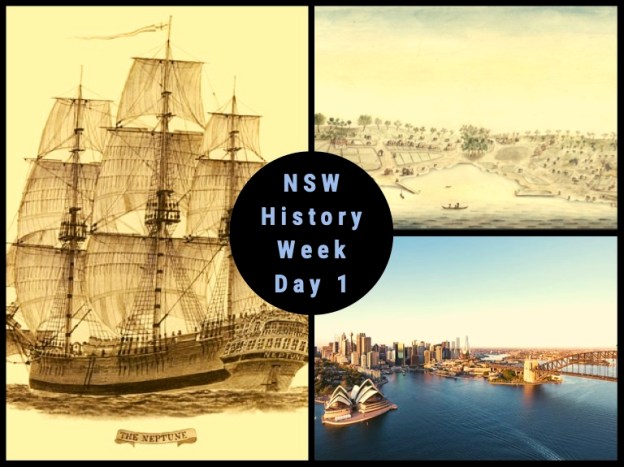
In support of NSW History Week 2022, I will share five stories that formed the basis of my research for my novel More Than I Ever Had. This book is based on the true story of Theophilus Feutrill, who enlisted in the New South Wales Corps in 1789 in Birmingham.

British settlement of Sydney Cove was eighteen months old, when Private Theo Feutrill, member of the newly formed New South Wales Corps, arrived in Port Jackson on the Neptune as part of the Second Fleet. At the time, Sydney Cove had a settler population of just over 1,000 people (including 736 convicts). When the six ships of the Second Fleet arrived in June 1790, the passengers (including the military and convicts) more than doubled the population number.

But before Theo arrived on the Neptune, the settlers, which arrived in 1788 (eighteen months earlier) had long been expecting to receive supplies from Great Britain. A great deal of frustration and anxiety was felt in the growing absence of ships, as supplies dwindled and precious food rations were reduced. Upon sighting the first ship to arrive since the First Fleet, on 3 June 1790, Lieutenant-Colonel David Collins wrote it was “to the inexpressible satisfaction of every heart in the settlement (that) the long-looked-for signal was made for a ship at the South Head. Every countenance was instantly cheered, and wore the lively expressions of eagerness, joy and anxiety.”

Captain Watkin Tench went a bit further in his journal: “At length the clouds of misfortune began to separate, and on the evening of the 3rd of June, the joyful cry of “the flag’s up,” resounded in every direction. I was sitting in my hut, musing on our fate, when a confused clamour in the street drew my attention. I opened my door, and saw several women with children in their arms running to and fro with distracted looks, congratulating each other, and kissing their infants with the most passionate and extravagant marks of fondness. I needed no more; but instantly started out, and ran to a hill, where, by the assistance of a pocket glass, my hopes were realized. My next door neighbour, a brother-officer, was with me; but we could not speak; we wrung each other by the hand, with eyes and hearts overflowing.”

Their joy was to be short-lived, however, to be replaced with “wonder and mortification” that the ship they saw (the Lady Juliana) contained not livestock and supplies as they had been expecting, but female convicts. The colonists soon learnt the sorry tale that a supply ship had been sent earlier, but had struck an iceberg just off the coast of South Africa. Three days after the sighting of the Lady Juliana near South Head in New South Wales, the passengers disembarked and it was “a little mortifying to find on board the first ship that arrived, a cargo so unnecessary and unprofitable as two hundred and twenty-two females, instead of a cargo of provisions.” When the women landed “many of them appeared to be loaded with the infirmities incident to old age, and to be very improper subjects for any of the purposes of an infant colony.” And “instead of being capable of labour” they appeared to be “never likely to be any other than a burthen to the settlement.”

However, the situation appeared to improve somewhat on the 20th when, at last, a storeship came in sight. The Justinian was the second ship in the Second Fleet to arrive, and it was greeted with great joy, but this welcome news was tempered as the colonists learnt “that three transports might be hourly expected, having on board (one) thousand convicts …. together with detachments of a corps raised for the service of this country.”

After the Justinian arrived, the full food ration was reinstated to be “issued weekly”, and “the drum for labour was to beat as usual in the afternoons at one o’clock.” With replenished stores, Lt.-Col. David Collins wrote: “How general was the wish that no future necessity might ever occasion another reduction of the ration, or an alteration in the labour of the people.” With our telescope looking back through the years, knowing what is ahead for these people, we realise it is a futile wish.

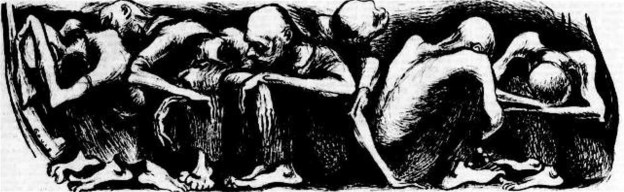
Nearly three weeks later, the transport ships Surpize, Neptune (with Theo Feutrill onboard) and Scarborough arrived and from that point onward, the Second Fleet was to be forever known as the worst fleet ever to arrive in Australia—and the Neptune was regarded as the worst ship of them all. As the colonists gathered to watch passengers and convicts disembarking they were in a for a shock. Lt.-Col. David Collins wrote that two hundred people arrived sick, but Capt. Watkin Tench had the number closer to five hundred. As the condition of the passengers and convicts became obvious, Lt.-Col. David Collins wrote “the west side (of Sydney Cove) afforded a scene truly distressing and miserable; upwards of thirty tents were pitched in front of the hospital (the portable one not being yet put up); all of which, as well as the adjacent huts, were filled with people, many of whom were labouring under the complicated diseases of scurvy and the dysentery, and others in the last stage of either of those terrible disorders, or yielding to the attacks of an infectious fever.”

As months passed, the devasting numbers of deaths became known. History records show if you measure passenger survival of those who sailed on the Second Fleet from the time they left England and to within eight months of arrival in Sydney, the convict mortality rate was around a shocking 40 per cent. Much outrage was expressed to the Home Secretary back in Great Britain, and contracts for convict transportation were immediately changed. The story of the Second Fleet is the subject of my blog The Scandal of the Second Fleet, which can be found on my website.

Despite the horrors passengers and convicts experienced sailing to New Holland on the Neptune, the landing of this notorious ship in Sydney Cove on 28 June 1790, began Private Theo Feutrill’s association with the land to become known as Australia. His efforts, and those who came out on the First, Second and subsequent fleets, forged a country which has been home to at least eight generations of his family.

The novel, based on Theo Feutrill’s life called More Than I Ever Had, is available from independent booksellers in Sydney and also from Amazon (link to Amazon Australia site here.)

The scandal of the Second Fleet

So much is known about the First Fleet that sailed to Botany Bay in 1788. But, less is known about the Second Fleet that followed it two-and-a-half-years later. My novel More than I ever had, tells the real life story of Theo Feutrill, a young Englishman who enlists in the New South Wales Corps in Birmingham, and is allocated a berth onboard the Neptune to sail to Sydney Cove as part of the Second Fleet. The Second Fleet became notorious for a reason, and when Theo steps onboard has no idea what’s ahead of him.

*

Why was there even a First Fleet?

When America said a polite ‘no thank you, not any more’ to the British, refusing to take further convicts on their shores (I think the American War of Independence had something to do with it) Britain ceased transportation of its convicts from 1776 to 1788. As a result, the prison population in Britain swelled. Rather than overhaul the crime and punishment system, authorities made the disastrous decision to house prisoners in ship hulks anchored in rivers and along sheltered coastlines. Disease was rampant, and conditions so bad, about a third of the prisoners died. Something had to be done.

In 1783, the idea of using Botany Bay as the new penal colony was proposed, and by May 1787 a fleet of ships, the First Fleet, led by Governor Arthur Phillip, sailed from Portsmouth and arrived in Botany Bay on 18 January 1788. This fleet of eleven ships contained six convict transports carrying 751 convicts—but unfortunately it did little to alleviate the over-crowded conditions on the prison hulks.

Once word was received from Governor Phillip that the First Fleet arrived and a colony was in the process of being established, the decision was made to send a Second Fleet.

While the First Fleet had a low mortality rate (5.4%), it was very expensive at £55,000. The ships contractor, William Richards, was a humanitarian and devout Christian, so he ensured the ships stopped often and were well supplied. To make savings for the Second Fleet, the government put the contract out to tender for three ships to transport prisoners to Sydney Cove. After the bidding process, the lowest bid was accepted (less than half of the cost of the First Fleet). William Richards was unsuccessful in his bid, instead the contract was awarded to Camden, Calvert & King—the largest company in London involved in the slave trade. What could go wrong?

Camden, Calvert & King were contracted to supply three ships (Scarborough, Suprize, and Neptune) and would receive £17.7.6 for each convict embarked. They also had the ability to sell any left-over provisions at Sydney Cove. Also, in the contract, the ship’s captains had full control over their ships, the doling out of provisions, and the treatment of the convicts. Perhaps in the hands of a different contractor, this contract could have worked to the benefit of all. But the masters on these ships were later described as: low-lifed and barbarous.

Through a dispute with the military onboard the Neptune, its master was replaced before the ship even left English waters, and in his stead was a man later described as a demented sadist and by Elizabeth Macarthur as a perfect sea-monster.

To make up the Second Fleet, the three Camden, Calvert & King prisoner transport ships were joined by Justinian (storeship), naval warship Guardian (primarily transporting stores but scuttled by an iceberg near South Africa) and Lady Juliana (contracted by William Richards, which transported exclusively female convicts).

A naval agent was appointed to monitor the captain and crew of contracted ships, but the one appointed to monitor Camden, Calvert & King’s ships did a questionable job. The master of the Guardian wrote later:

…if ever the navy make another contract like that of the last three ships they ought be shot, and as for their agent Mr Shapcote he behaved here just as foolishly as a man could well do.

Captain William Hill who travelled on Suprize with half of his men (the other half were on Neptune) wrote after his voyage:

The slave trade is merciful compared with what I have seen in this fleet.

So, we have ship masters of dubious character who have full control over provisions and how the convicts are treated. The contracting company is paid a set fee whether the convicts arrive alive or not, and there’s an incentive to not only withhold supplies from both convicts and passengers but to have less mouths to feed, as the captain and crew were set for financial gain by selling the left-over provisions when they arrived at the new colony.

Of the nearly 1,000 convicts onboard the Second Fleet, 261 male and 16 female convicts died on the voyage (plus four children) and another 150 convicts were dead within months of their arrival in the colony. In other words, if you measure survival within eight months of arrival in Sydney, the mortality rate of Second Fleet convicts was around 40 per cent. Compare the death rates by ship:

  • Lady Juliana (5 women, 2 children)
  • Suprize (42 men)
  • Scarborough (68 men)
  • Neptune (151 men, 11 women and 2 children)

The shocking mortality rate of the Second Fleet was nearly ten times that of the First Fleet voyage, and Theo Feutrill—the main protagonist in my book—is right in the thick of it as a passenger onboard the Neptune.

Following the outrage that occurred after the Second Fleet ships landed at Sydney Cove, the British government changed the way it contracted transport ships in the future. Amongst other things, contractors were paid for each convict that arrived in Sydney Cove alive.

*

More than I ever had More Than I Ever Had is a novel based on a true story by Rae Blair, and is available world-wide on Amazon Kindle in eBook and paperback formats.