Tag Archives: NSW History Week

NSW History Week – Day 5

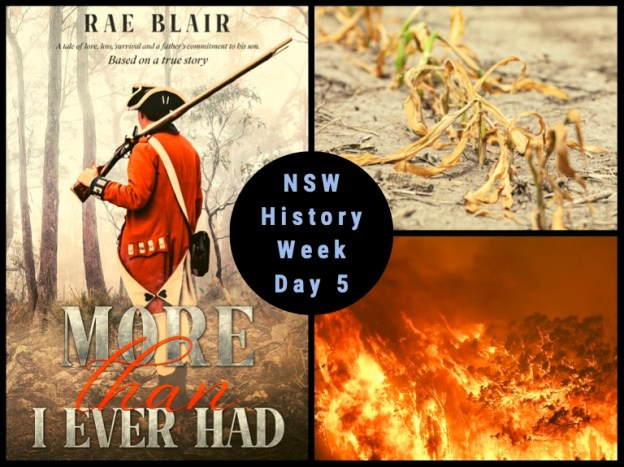
This is my last post for NSW History Week 2022. In this post, I focus on Australia’s harsh environment that the European settlers were faced with. Today, we battle bushfires with modern technology. Back, more than two hundred and thirty years ago, fires were fought with hessian sacks and branches from trees and shrubs. What a challenging world they found themselves in.

A land of drought and fire

How could early European settlers foresee how challenging it would be to grow crops and ensure the survival of livestock in the new penal colony—especially using techniques employed in the northern hemisphere. How would they know how difficult it would be to even live in this country? The settlers of New South Wales battled with flooding rains, drought, humidity and scorching heat, as well as fires started either by lightning strikes or from hunting or land management practices of First Nations people.

Lieutenant Watkin Tench in his journal makes mention of the practices of setting fire to the grass: “The country, I am of opinion, would abound with birds, did not the natives, by perpetually setting fire to the grass and bushes, destroy the greater part of the nests; a cause which also contributes to render small quadrupeds scarce: they are besides ravenously fond of eggs, and eat them wherever they find them. — They call the roe of a fish and a bird’s egg by one name.”

And

“When the Indians in their hunting parties set fire to the surrounding country (which is a very common custom) the squirrels, opossums, and other animals, who live in trees, flee for refuge into…holes, whence they are easily dislodged and taken.”

The effect of heat and fire on the country and its inhabitants is well recorded by Lieutenant-Colonel David Collins, Lieutenant Watkin Tench and Mrs Elizabeth Macarthur.

Fire threatened the settlement of Sydney Cove in December 1792 as Lieutenant-Colonel David Collins noted: “The weather during December had been extremely hot. On the 5th the wind blew strong from the northward of west ; and, to add to the intense heat of the atmosphere, the country was everywhere on fire. At Sydney, the grass at the back of the hill on the west side of the cove, having either caught or been set on fire by the natives, the flames, aided by the wind which at that time blew violently, spread and raged with incredible fury. One house was burnt down ; several gardens with their fences were destroyed, and the whole face of the hill was on fire, threatening every thatched hut with destruction.

The conflagration was, with much difficulty (notwithstanding the exertions of the military) got under, after some time, and prevented from doing any further mischief. At different times during this uncomfortable day distant thunder was heard, the air darkened, and some few drops of rain fell. The apparent danger from the fires, drew all persons out of their houses and on going into the parching air, it was scarcely possible to breathe, the heat was insupportable; and vegetation seemed to suffer much, the leaves of many culinary plants being reduced to powder. The thermometer in the shade rose above one hundred degrees. Some rain falling toward evening, this excessive heat abated.

At Parramatta, and Toongabbe, also, the heat was extreme ; the country there too was every where in flames. One settler was a great sufferer. The fire had spread to his farm; but, by the efforts of his people and neighbours was got under, and its progress supposed to be essentially checked, when an unlucky spark from a tree, which had been on fire to the top most branch, flying upon the thatch of the hut where his people lived, it blazed out, and the hut, with all the out-buildings, and thirty bushels of wheat just got into a stack were in a few minutes destroyed : the erecting of the hut and out-houses (were made) a short time before. We are prepared for the smile which will follow the detail of this loss; a house,with out-houses which cost fifteen pounds, and thirty bushels of wheat to be deemed of sufficient consequence to find a place in the history of a country. Recollect, however, gentle reader, that country was not Great Britain; it was the infant, the distressed settlement of Port Jackson; and circumstances are great or small only by comparison. The man who lost his few pounds, his little all in New South Wales, deplored it as much as he who in a happier land had lost his thousands. This poor man was made a beggar by his calamity; and the man of wealth could not have suffered more.”

Used to the temperate climate of Great Britain, the colonists were in for a rude shock at the intensity of the sun blazing in the new country—blighting their efforts at using timber:

“The timber that had been cut down proved in general very unfit for the purpose of building, the trees being for the most part decayed ; and when cut down they were immediately warped and split by the heat of the sun.”

And during the summer months of the new country soaring and sustained temperatures rendered the crops to dust. David Collins makes a note of this in March 1791:

“At Rose Hill, the heat on the tenth and eleventh of the month, on which days at Sydney the thermometer flood in the shade at 105º was , so excessive (being much increased by the fire in the adjoining woods), that immense numbers of the large fox bat were seen hanging at the boughs of the trees, and dropping into the water, which, by their stench, was rendered unwholesome. They had been observed for some days before regularly taking their flight in the morning from the north-ward to the southward, and returning in the evening. During the excessive heat many dropped dead while on the wing ; and it was remarkable, that those which were picked up were chiefly males. In several parts of the harbour the ground was covered with different sorts of small birds, some dead, and others gasping for water.

The relief of the detachment at Rose Hill took place on one of those and the officer, having occasion to land in search of water, was compelled to walk several miles before any could be found. Sultry days ; the runs which were known being all dry: in his way to and from the boat, he found a number of birds dropping dead at his feet. The wind was about north-west, and did much injury to the gardens, burning up every thing before it. Those persons whose businesss compelled them to go into the heated air declared, that it was impossible to turn the face for five minutes to the quarter from whence the wind blew.”

In November 1791, David Collins noted the number of hospitalisations from the heat had increased and a convict died of sunstroke:

“The mortality during the month of November had been great, fifty male and four female convicts dying within it. Five hundred sick persons received medicine at the end of that time. The extreme heat of the weather had not only increased the sick lift, but had added one to the number of deaths. On the 4th, a convict attending upon one of the gentlemen, in passing from his house to his kitchen, with-out any covering upon his head, received a coup de soleil which at the time deprived him of Speech and motion, and, in less than four-and-twenty hours, of his life. The thermometer on that day stood at twelve o’clock at 943/4º and the wind was N.W.”

And in December 1792, Collins noted the reduction of working hours due to the heat: “The convicts had more time given to them, for the purpose not only of avoiding the heat of the day, but of making themselves comfortable at home. They were directed to work from five in the morning until nine; rest until four in the afternoon, and then labour until sunset.”

In 1796, the high temperatures made wheat a crop with an uncertain future:

“Cultivation was confined to maize, wheat, potatoes, and other garden-vegetables. The heat of the climate, occasional droughts, and blighting winds, rendered wheat an uncertain crop : The harvests of maize were constant, certain, and plentiful; and two crops were generally procured in twelve months.”

In January 1797:

“The Governor, on reaching Toongabbe, had the mortification of seeing a stack containing eight-hundred bushels of wheat burnt to the ground, and the country round this place every where in flames: unfortunately, much wheat belonging to Government was stacked there. The fire had broke out in the evening ; the wind was high, the night extremely dark, and the flames had mounted to the very tops of the lofty woods that surrounded a field called the Ninety Acres, in which were several stacks of wheat. The appearance was alarming, and the noise occasioned by the high wind, and the crackling of the flames among the trees, contributed to render the scene truly awful.

It became necessary to make every effort to save this field and its contents. The jail-gang, who worked in irons, were called out, and told, that if the wheat was saved by their exertions, their chains should be knocked off. By providing every man with a large bush, to beat off the fire as it approached the grain over the stubble, keeping up this attention during the night, and the wind becoming moderate towards morning, the fire was fortunately kept off; and the promise to the jail-gang was not forfeited.

Although at this season of the year there were days when, from the extreme heat of the atmosphere, the leaves of many culinary plants growing in the gardens were reduced to a powder, yet there was some ground for supposing that this accident had not arisen from either the heat of the weather or the fire in the woods. The grain that was burnt was the property of Government, and the destruction made room for as many bushels as should be destroyed, which must be purchased from the settlers who had wheat to sell. If, however, this was the diabolical work of designing selfish villains, they had art enough to baffle the most minute inquiry.”

And in February 1797:

“Erecting a granary, completing a wind-mill, and repairing the public roads, formed the principal works during January; in which the weather had been most uncomfortably hot, accompanied with some severe thunder storms, during one of which both the flag-staff at the South Head, and that at the entrance of the Cove, on Point Maikelyne, were shivered to pieces by the lightning.

The vast blazes of fire which were seen in every direction, and which were freshened by every blast of wind, added much to the suffocating heat that prevailed.”

And

“The weather was now becoming exceedingly hot ; and as, at that season of the year, the heat of the sun was so intense that every sub-stance became a combustible, and a single spark, if exposed to the air, in a moment became a flame, much evil was to be dreaded from fire. On the east side of the town of Sydney, a fire, the effect of intoxication or carelessness, broke out among the convicts’ houses, when three of them were quickly destroyed ; and three miles from the town another house was burnt by some runaway wretches, who, being displeased with the owner, took this diabolical method of shewing their ill-will.”

In January 1799:

“The wheat proved little better than chaff, and the maize was burnt up in the ground for want of rain. From the establishment of the settlement, so much continued drought and suffocating heat had not been experienced ; the country was in flames, the wind northerly and parching ; and some showers of rain which fell on the 7th were of no advantage, being immediately taken up again by the excessive heat of the sun.

March 1799:

“The great drought and excessive heat had affected the water. Such ponds as still retained any were reduced so very low, that most of them were become brackish, and scarcely drinkable. From this circumstance, it was conjectured, that the earth contained a large portion of salt ; for the ponds even on the high grounds were not fresh. The woods between Sydney and Parramatta were completely on fire, the trees being burnt to the tops ; and every blade of grass was destroyed.”

And the last word comes from Elizabeth Macarthur, in one of her letters dated 7 March 1791

“…in spite of Musick I have not altogether lost sight of my Botanical studies; I have only been precluded from pursuing that study, by the intense heat of the Weather, which has not permitted me to walk much during the Summer, the Months of December, and January, have been hotter than I can describe, indeed insufferably so. The Thermometer rising from an 100 to an 112 degrees is I believe 30 degrees above the hottest day known in England – the general heat is to be borne – but when we are oppressed by the hot winds we have no other resource – but to shut up ourselves in our Houses and to endeavor to the utmost of our power to exclude every breath of air – This Wind blows from the North, and comes as if from a heated oven. Those winds are generally succeeded by a Thunder storm, so severe and awful, that it is impossible for one who has not been a Witness to such a Violent concussion of the Elements to form any notion of it. I am not yet enough used to it, to be quite unmoved, it is so different from the Thunder we have in England. I cannot help being a little Cowardly, yet no injury has ever been suffer’d from it, except a few sheep being kill’d which were laying under a Tree, that was struck by the Lightning, a Thunder storm has always the effect to bring heavy rain, which cools the air very considerably. I have seen very little rain, since my arrival, indeed I do not think we have had a Weeks rain in the whole time: the consequence of which is, our Gardens produce nothing, all is burnt up, indeed the soil must be allow’d to be most wretched and totally unfit for growing any European productions tho’ a stranger would scarcely believe this, as the face of the ground at this moment, where it is in its native state is flourishing even to Luxuriance; producing fine Shrubs, Trees, and Flowers, which by their lively tints, afford a most agreeable Landscape. Beauty I have heard from some of my unletter’d Country Men is but skin deep, I am sure the remark holds good in N: S: Wales.”

European settlers persevered and learnt many lessons in how to live and thrive in the harsh environment that is Australia. Today, we still battle with raging bushfires and devastating drought. Science and technology is more important than ever to enable Australians to grow food and thrive in an increasingly hostile and unreliable environment, but we take some comfort in realising that our environment today is not so very different from that more than two hundred years ago.

**

‘More Than I Ever Had’ is based on the true story of Theophilus Feutrill, who came to Sydney Cove in 1790 as part of the Second Fleet as a private in the NSW Corps. The book is available from independent booksellers in Sydney and Amazon.

NSW History Week – Day 3

Military mayhem in 1796

In support of NSW History Week 2022, here is the third of five stories that formed the basis of my research for my novel More Than I Ever Had. This book is based on the true story of Theophilus Feutrill, who enlisted in the New South Wales Corps in 1789 in Birmingham.

In February 1796, Theophilus Feutrill was one of four people whose name was on an arrest warrant issued by the Governor of New South Wales, John Hunter. If found guilty of the charges, the men named would be “obliged to answer for it, most probably with their lives.”

What were the circumstances that lead to this arrest warrant being issued? And, could Theo Feutrill, and the three other privates whose names were on the arrest warrants, really be the masterminds behind what happened, or where they just the scapegoats?

When John Hunter took over as Governor of New South Wales in September 1795, he knew he had a tough job ahead of him. The settlement was largely dependent on rum as currency and much at the mercy of the monopolistic trading practices of the military hierarchy and other officials. He complained in harsh terms to the Duke of Portland (one of the three Secretaries of State, who Hunter reported to) about the quality of the military members:

“…I should feel myself deficient in that duty which I owe to his Majesty’s service in this part of the world were I not to take a liberty which I have no reason to believe your Grace will be offended at—I mean, in remarking that the manner in which this corps has, since employed upon this service, been recruited does in a great measure weaken the effect or service which we would expect to derive from the assistance of the military. Soldiers from the Savoy,* and other characters who have been considered as disgraceful to every other regiment in his Majesty’s service, have been thought fit and proper recruits for the New South Wales Corps, which, in my humble opinion, my Lord, should have been composed of the very best and most orderly dispositions. They are sent here to guard and to keep in obedience to the laws, when force may be requisite, a set of the worst, the most atrocious characters that ever disgraced human nature; and yet we find amongst those safeguards men capable of corrupting the heart of the best disposed, and often superior in every species of infamy to the most expert in wickedness amongst the convicts. Our stores, provisions, and granaries must be intrusted (sic) to the care of those men: what security can we have in the hands of such people?”

*The Savoy was the name of the prison which housed military offenders.

At the time, Governor Hunter was approaching the age of sixty. Those who supported him were significantly younger: Captain Paterson, the commander of the Corps was forty; Captain John Macarthur, Inspector of Public Works, was twenty-eight. No others were older than Paterson. In the absence of a free press where independent commentary might have reached those back in London, the Duke of Portland relied not only on dispatches from Hunter, but he was also being petitioned by the likes of the ambitious John Macarthur, who held little back in his criticisms of the administration.

Governor Hunter’s leadership was tested following an event which occurred on 5 February 1796, and is considered to be the catalyst for the Duke of Portland to eventually recall him to England and replace him as Governor. In a letter from Governor Hunter to the Duke of Portland dated 10 August 1796 (which was not acknowledged by Portland until more than a year later on 31 August 1797), Hunter outlines an event which he describes as an ‘outrage’. An abridged version of his report is below:

“Statement of the Case of John Baughan.

John Baughan…foreman of the carpenters working at Sydney, and a private soldier of the New South Wales Corps, (also a carpenter), had some dispute when formerly working together… This dispute, it appeared, had not subsided in the min of the soldier, and was probably not wholly forgot by the other.

…One day when sentinel over a storehouse, knowing that Baughan was at work in a house some distance from his post, (the Private) set his arms down against the wall of the store, and seeing a man whom he knew standing on the outside of the building in which Baughan was at work, entered into a conversation with him, of which Baughan was the subject, and which much abuse was bestowed, (and)… meant for Baughan (to) (over)hear.

Baughan went out at the back door unperceived, and seeing the soldier without his arms, went to his post, where he found the musquet, which he took up and carried to the guard-house, and delivered to the Serjeant (sic) of the guard. The soldier was, of course, taken notice of and relieved, being without his arms.

The next day, 5th February, at half-past nine o’clock in the forenoon, the whole of the corps off duty at this place assembled, and in the most public and tumultuous manner proceeded to the dwelling of John Baughan, broke open his gates, doors, and windows, entered his house, chopped the corner-posts of it, broke his bedsteads and bedding, chairs, window-frames, drawers, chests, and, in short, completely demolished everything within his possession to a considerable amount, for the man had, by great labour and industry, built himself a neat house, and had it well furnished.

Upon their first approach, having had a few minutes’ notice, he armed himself with a loaded gun and defended himself by threats for some time, but their numbers were so many that they surrounded his paling which inclosed (sic) the house, which some tore down and entered on the opposite side to that which he endeavoured to defend, came behind him, secured and threw him down, with his face to the ground, whilst one held an axe over his neck, and swore if he offered to stir he would chop the head from his body. During the time he remained in this situation they completed the ruin of his whole property, to the very great terror of the man’s wife, after which they went off cheering, as if something meritorious had been effected, and marched in a body cross the parade before their commanding officer’s house.

After so daring an attack, in the open day, upon the dwelling-house of an inhabitant, and in direct defiance of all law, civil or military, they could only be considered as in a state of mutiny. I immediately issued in Public Orders the paper No. 2.”

Public Orders Paper #2 is reproduced below:

Government and General Order.  5th February, 1796.

“The very riotous manner in which the soldiers have conducted themselves this morning, and the very unwarrantable liberty they have thought proper to take in destroying the dwelling-house of John Baughan, is so flagrant a crime against the laws established in this colony that nothing but the want of proof to substantiate who the principal actors in this disgraceful business were could possibly prevent their being immediately tried for so glaring an offence against the peace of the colony.

The Governor thinks it necessary to assure the soldiers that he considers their conduct upon this occasion to have been disgraceful to the character of a British soldier, and that he did hope to have found men amongst them who would have had pride enough to have stood forward and pointed out the ringleaders of so mutinous a conduct, for in no other light can it be considered than that of mutiny when the military assemble in such numbers unknown to their officers, who are at all times ready to listen to any complaints they may have to make, and to see that agreeable to common justice they are redressed. If the soldiers expect that the Governor or any of the officers in this settlement can hereafter consider them as…meriting the honorable appellation of British troops, it must be by their bringing forward the ringleaders or advisers of this disgraceful conduct, in order that the stigma may be wiped away by such worthless characters being brought to trial for this shameful conduct.”

The reception of the Public Orders and mood of the soldiers is indicated by Governor Hunter in his letter to the Duke of Portland:

“But as an alteration in the ration had at that very time been ordered, I think it necessary to observe that their temper at the moment was so violent that they positively refused to take it unless they were served all flour, instead of part flour and part corn, a desire which could not be complied with without manifest injustice to others, and also insisted upon being paid short-allowance money for the time they were on short ration, which they say Governor Phillip had promised them. This last demand I must request your Grace’s instructions upon.”

Governor Hunter met with the commander of the Corps, Captain William Paterson on 6 February and wrote to him the next day advising his change of heart (wisely) in wanting to address the soldiers directly. He couched his decision that to address them directly “would be a condescention on my part which their violent and unsoldierlike conduct does not entitle them to from me.” He goes on to say to Paterson: 

“I must declare to you, sir, that the conduct of this part of the New South Wales Corps has been,…the most violent and outrageous that was ever heard of by any British regiment whatever, and I shall consider every step they may go father in aggravation as rebellion against his Majesty’s government and authority, of which the most early notice shall be taken, and those concerned be in due time obliged to answer for it, probably with their lives.”

As previously mentioned, the Duke of Portland did not respond to Governor Hunter on this matter for more than a year, leaving the governor to deal with this without his support. The governor did, however, have the support of Doctor William Balmain who (without legal training) held the position of Judge-Advocate. From the military side, Captain John Macarthur represented the interests of the NSW Corps.

After the attack on his home, John Baughan, fearing further retribution, declined to identify those involved or to pursue the matter. Dr Balmain ‘proffered’ legal advice (some historians considered Balmain threatened Baughan with obstruction of justice should he not progress the matter ). After some days, four names were eventually given up. When the governor issued the arrest warrants, the military was further enraged at Balmain’s “shamefully malevolent interference in the affairs of the Corps”. One of the warrants was for the arrest of Theophilus Feutrill.

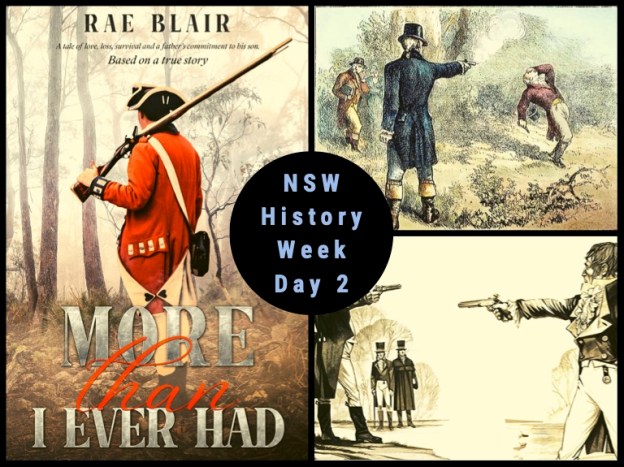
As the military were responsible for enacting the arrest warrants, Captain John Macarthur approached the governor and stalled the process. Thus began a test of strength between the civil and military authorities. As Theophilus fretted over his fate—he was facing potential execution if found guilty—a series of letters was exchanged between Judge Advocate Balmain (representing the civil authority) and Captain John Macarthur (representing the military). Tempers frayed and insults given to the point that Balmain told Macarthur he was “a base rascal and an atrocious liar and villain”. Balmain then challenged Macarthur to a duel, which was subsequently withdrawn.

Captain Macarthur approached the Governor in the name of the Corps and was “expressive of their contrition, their sincere concern for what had happened, promising at the same time that they would endeavour by their future conduct to wipe away the odium which this recent instance of disorder and want of respect for the laws, the peace, and order of the settlement had brought upon them; they also agreed to indemnify the sufferer for his loss.” Upon receiving this message from Macarthur, and by the personal petition of the sufferer, John Baughan, the governor ordered the warrants to be withdrawn as “the consequences would otherwise most probably have been fatal to some.”

Peace was restored, but the Duke of Portland saw Hunter’s capitulation as weakness in his leadership.

John Hunter was recalled to London in a stern dispatch from Portland dated 5 November 1799. The withdrawal was acknowledged by Hunter on 20 April 1800, and he handed over the government to Lieutenant-Governor King on 28 September.

Why was Theophilus Feutrill’s name included on the arrest warrant? The Governor wanted the members of the military to come forward and give up the names of the ring leaders. But it appears unlikely that a private soldier would have the compelling presence or authority to whip up “all off-duty military members” to such an action. Was he, and the other privates listed just scapegoats, or were they more involved? The records are silent, but it is easy to imagine the relief he and his wife Ann would have felt upon hearing the warrants were withdrawn.

**

‘More Than I Ever Had’, based on the true story of Theophilus Feutrill, is available from independent booksellers in Sydney and Amazon.
NSW History Week – Day 2 part III

Duelling personalities: Part III

In support of NSW History Week 2022, here is part III of the second of five stories (presented in three parts) that formed the basis of my research for my novel More Than I Ever Had. This book is based on the true story of Theophilus Feutrill, who enlisted in the New South Wales Corps in 1789 in Birmingham.

Duel number three: Paterson v Macarthur 1801. Petty grievances

An article published in the Australian Star in September 1896, recounts a long-winded story about Sydney’s “first duel”*. It says “The whole affair is contained in the correspondence, official and private, and the tediousness is entirely due to the childish tetchiness, the elaborate slyness and the queer prolixity of many of the persons concerned. These were almost every individual of any station in the little community in the year 1801 of the occurrence.”

I’ll boil down the story as much as I can, but the whole issue begins with a drowning enroute to New South Wales. The drowned man’s effects were taken by the naval agent, Lieutenant Marshall, who replaced them with inferior products. Lieutenant John Macarthur—who was the temporary officer commanding the New South Wales Corps, in the absence of Colonel William Paterson—became aware of the swindle and took the matter up. The Governor severely reprimanded Lieutenant Marshall and sent him back to England on the next whaler. The article writes: “Marshall, resenting Macarthur’s action in the matter, thereupon found means to insult Captain Macarthur, who promptly sent Captain Abbott, of his corps, with a challenge. Lieutenant Marshall accepted.”

The problem was that Lieut. Marshall named a Mr Jefferies (purser of the Cornwallis) as his second. Macarthur was “up to his eyes in trade in spirits and every other commodity” so he ‘loftily objected’ and he would “by no means recognise (Jefferies) as second to his adversary.” Marshall duly attended the duel at the specified time and place, but Macarthur kept away. Enraged, Marshall “provided himself with a cudgel and went in search of (Macarthur).” Marshall found Captain Abbott in the doorway to Macarthur’s office, and he “dealt Captain Abbott a lusty thump on the ribs” then went in pursuit of Macarthur. When approached, Macarthur “(drew) his sword, (and) threatened to run the angry lieutenant through the body.” Marshall was arrested and taken to the guard-house.

Governor King then ordered that Lieut. Marshall should be tried by criminal court for assault against Abbott and Macarthur. By this time, Colonel Paterson had returned and “the court was property constituted with him, four other officers of the NSW Corps, Lieut. Grant and the Judge Advocate.” Whilst the case against Marshall for his “shady transaction with respect to the personal effects of the (drowned person)”, was straightforward, “Macarthur’s refusal to meet Lieut. Marshall in a duel appears to have been…impertinent, inasmuch as according to Governor King, he subsequently entertained at dinner at his own house, in company with Captain Abbott, the very man on whose selection as second to Lieutenant Marshall he alleged his disinclination to appear in the field.” Marshall “took objection to the constitution of the court” being made up of NSW Corpsmen, which was denied. Whilst Governor King did not intervene during the trial (Marshall was found guilty and sentenced to 12 months prison), he was provided with a record of the proceedings where there was “little doubt that the proceedings were conducted with distinct animus against the prisoner.” The Governor considered the appeal of the prisoner rested “on grounds solid enough to require serious attention. He instructed the court reconvene to investigate the allegations “not only to defend its own integrity, but to afford the most unequivocal justice to the prisoner…” The members of the court met, but refused to comply and “immediately dispersed.” The Governor said that he would “bring the business under the notice of the Secretary of State, and ask for support of his authority.” The five military members of the court wrote a letter asking for a copy of Marshall’s protest. The Governor refused, as the five military members were only a part of the seven member court. This pitted the five military members against the two others, and the officers “got savage and rather desperate. They agreed amongst themselves to cut the Governor socially. But this course proved too compromising (for) Colonel Paterson (who) quietly seceded. He resumed his ordinary relations with the Governor. Macarthur was furious.”

And this is where things become petty and dangerous.

Macarthur “threw the obligations of military discipline to the winds. He cast aside the obligations of a gentleman. He divulged private conversations with the colonel, he disclosed confidential communications. He stooped so low as to exhibit a private and familiar letter from Mrs Paterson to Mrs Macarthur. The fact was that the colonel had not been at all guarded in his demeanour and acts with relation to the Governor. He had criticised. He had sneered. He had even …(written)…to Sir Joseph Banks and General Brownrigg attacking the Governor’s public character and transactions. Macarthur had participated in these indiscretions. There are indications that he had instigated them. He now threw the burden of them on his colonel.” Colonel Paterson responded by doubling-down on his relationship with the Governor, and sent Macarthur a challenge.

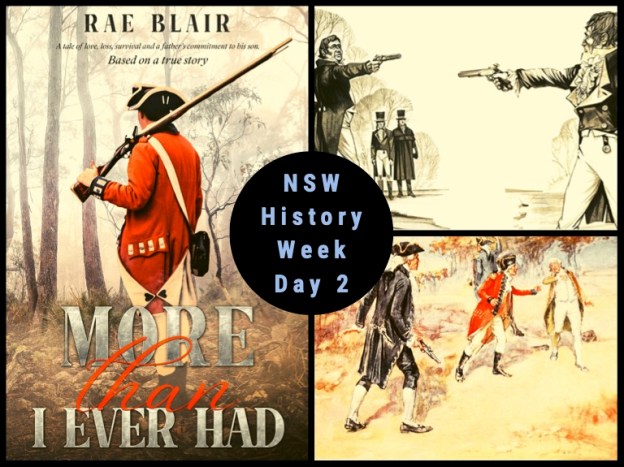
The duel took place—Colonel Paterson chose Captain McKellar as his second, Macarthur chose Captain Piper. A scandal occurred when contrary to “all the proprieties” Macarthur was permitted to load his own pistols, rather than his second, which was the proper course of action. Macarthur asserted “there was something the matter with the locks (on his) pistols (and) it wasn’t safe for anyone unacquainted with their peculiarities to wad them…” Captain Piper, Macarthur’s second, won the toss for first shot.

The combatants stood at a distance and side-on, to make themselves as small a target as possible. Macarthur had first shot and “it took effect in the Colonel’s right shoulder. He was disabled and could not return the fire. A week later, his life was not out of danger. The Governor, of course, heard of the affair” and arrest warrants were issued to all those involved (except for the wounded man, Colonel Paterson).

The pettiness continued.

The Governor ordered Macarthur to Norfolk Island, but Macarthur refused to be released from prison. He demanded “reasons for being put under arrest…and for being ordered out of arrest.” Correspondence “hailed on everybody and from everybody, and a regular devil’s brew of cavils, assertions and explanations bubbled in a joint stock pot. Surgeons, adjutants, chaplain, judge advocate, surveyor, ensigns, lieutenants, captains, all had a finger in the mess. The Governor, while yet the pot was in full boil, got rid of Lieutenant Marshall…(by) shipping him off to be dealt with in England. As Macarthur positively would not be ordered out of arrest, he was got rid of in the same fashion, fighting tooth and nail to the last hour, and very nearly managing to bring about a small insurrection by treating his detachment of New South Wales Corps to a dinner and grog, such grog being removed from store without a permit, intercepted and seized by the officer of the guard, and all but violently rescued by the soldiery for whose benefit it had been intended.”

Whilst Macarthur was shipped off to England, he returned and was embroiled in the Rum Rebellion of 1808, but that, of course, is another story 😊

**

‘More Than I Ever Had’ based on the true story of Theophilus Feutrill is available from independent booksellers in Sydney and from Amazon. Link to Amazon Australia site here.

NSW History Week – Day 2 – Part II

Duelling personalities: Part II

In support of NSW History Week 2022, here is part II of the second of five stories (presented in three parts) that formed the basis of my research for my novel More Than I Ever Had. This book is based on the true story of Theophilus Feutrill, who enlisted in the New South Wales Corps in 1789 in Birmingham.

Duel number two. Ross v Hill 1791. A fight for justice

Whilst this duel was fought in Sydney in December 1791, the fuse was lit in Norfolk Island. But, first, you need a bit of background on the combatants. Major Robert Ross was appointed lieutenant-governor of New South Wales in 1786 and he arrived in Sydney Cove with the First Fleet in January 1788. At the time Major Ross was the commander of the New South Marines and he had very firm views as to the establishment of the settlement—often at odds with those of Governor Phillip. Phillip endured this for over two years, but in March 1790, he saw an opportunity to remove the key source of friction from Sydney Cove, and sent Ross to take charge of Norfolk Island. Whilst this finally gave Phillip some breathing space, the British government had already decided to recall the fractious Major Ross and his New South Wales Marines, and a replacement military presence was already on its way—the New South Wales Corps—which included Private Theophilus Feutrill as part of the Second Fleet.

Now, over 1,000 miles away from Sydney Cove, Major Robert Ross was finally free to show everyone how a settlement ought to be developed. But, after the Sirius was dashed on the rocks, Ross declared martial law on the island, and removed the convicts from the government’s food stores—instead they had to grow their own food in the limited time available to them. Ross requested extra resources come to the island to ramp up development, and Captain William Hill was instructed to take a detachment of twenty-six men with him to Norfolk Island—and that included Theo Feutrill.

Once there, Captain William Hill clashed constantly with Major Ross, about the brutality of his punishments and his inhumane policies (all of which were abolished by Ross’s successor). He wrote numerous reports back to Governor Phillip. When Captain Hill and his men’s tenure was over at Norfolk Island, a replacement detachment arrived, but also onboard was a replacement for Major Ross as commandant of the Island. Captain Hill and his men boarded the Queen, as did Major Robert Ross and his second-in-command Ralph Clark (Quartermaster General and Keeper of the Stores). Whilst they awaited favourable winds to take them back to Sydney, Captain William Hill seized an opportunity to call Major Ross to account. Ralph Clark’s journal tells his side of the story:

“Wednesday, 16 November 1791

Captain Hill taken an unfair advantage of Major Ross by examining Convicts on Oath before the Revd. Mr. Johnstone and Mr. Balmain who are prejudice like himself against Major Ross fore these Said Convicts there are not greater rascals under heaven than they are and would Sell there fathers life if the[y] could get any thing by it.

Thursday 17th

The Queen in the Bay ——In her was Examined on Oath by Major Ross before Mr. Johnson and Balmain respecting a message which Mr. Hume Superintendant of the Convicts brought some time back to Major Ross from Chas. Gray Convict, which message he, Mr. Hume, said Major Ross forced him to Sign and Swear contrary to his inclination and wish, and that Mr. Faddy, Sergeant Kennedy and myself were present when he was forced ,which he informed Captain Hill and Swore Yesterday in Court —— also that he was forced when Faddy, Sergeant Kennedy and myself declared on Oath that he was not forced but on the Contrary was desired by Major Ross and myself repeatedly not to Sign or Swear to it if he did not like it or if there was any thing in it which was not as he had Related to Major Ross in the presence of Faddy and my Self —— he made answer to that there was not any thing contained but what he had Related and was perfectly Save in Signing it —— what a Rascal this Hume is.”

At this inquiry, Captain Hill had in his possession a report which was signed by a convict, Charles Gray. Gray declared under oath that Ross forced him to sign and swear the accuracy of the details in this report, which was contrary to his inclination and wish. Gray testified he was allocated to work at Queensborough, formerly known as Charlotte Field, and that he and many others made representation to (convict overseer) Mr Hume that they were not able to keep up, what they describe as ‘an impossible and punishing’ workload – a workload which had been set by Lieutenant Clark in his ambitions to complete the construction of the village.

Gray believed that word got back to Lieutenant Clark about what was said to Mr Hume, and that the Lieutenant ordered for his rations to be withheld, in punishment. But, not only his rations, but also the rations of his fellow workers, Thomas Strich and William Jones. Gray, Strich and Jones believed with no food they had no option but to leave the area to hunt for food for themselves.

Gray and Jones returned the same night, but Thomas Strich remained absent. Gray became a targeted man. On 23 May, a convict called James Thompson was cutting down a pine tree, when it fell onto him and broke his leg. Mr Gray and another convict, Michael Dennison, who were working nearby, attended to Mr Thompson, and carried him to the hospital for treatment. Lieutenant Clark punished Gray and Dennison’s absence with 200 lashes for Mr Gray and 25 for Mr Dennison. Then, on a further occasion, in October, Mr Gray received another 100 lashes for disobedience of orders and neglect of duty. It was at this point that Mr Gray lodged a formal complaint against Lieutenant Clark to Mr Hume—the basis of which that he had been singled out for special attention and unfairly punished.

Thomas Strich decided to return in June 1791. The reason for not punishing Strich upon his return was that Major Ross considered that the trouble and hardship Strich must have suffered in mind and body from the weather when he was away, and want of clothes, was a sufficient punishment for him in running away. Major Ross had forgiven him his crimes. At the inquiry, Captain Hill suggested that Major Ross struck a deal with Strich, that he would be saved the lash, if he informed on his fellow convicts.

Captain Hill suggested that when Mr Hume came to Major Ross with the formal complaint from Charles Gray, Ross called Gray to his office. As Gray could not read or write, Ross called Lieutenant Clark into his office, and Ross dictated Gray’s complaint for Clark to write down. Although, what Ross had Clark write down, put a different view on the complaint, and put both Ross and Lieutenant Clark in a more favourable light. Gray was then forced to swear to the accuracy of the report and sign it.

Clark said that he and Major Ross told Gray not to sign or swear to the report if he did not like what was said, or if there was anything in it which was not as he had related to Major Ross. Before Gray signed the report, Ross also called Lieutenant William Faddy into the room—a lieutenant with a reputation that the convicts fear. Gray felt he had no option but to sign the document Ross and Clark had constructed.

Ross was furious with Captain Hill’s interference, and saw it as an attempt to besmirch his reputation. He challenged Hill to a duel upon their return to Sydney Cove. Captain Hill received a message on 11 December 1791 which read:

0600 tmrw. Field nth of Marine Camp. Bring a 2nd. signed by Major R. Ross.

Following is a deleted scene of the duel from More Than I Ever Had, which I couldn’t fit into the printed version:

On 12 December 1791, Major Robert Ross and Captain William Hill—accompanied by their seconds and an impartial observer—gathered in the field just north of the Marine Camp at 6:00 am. Theo and James Bannister stood in amongst the other onlookers. Theo hadn’t slept, tossing in his cot with worry for his captain. William Douglas joined them, hair askew from his pillow.

The crowd shared low, expectant chatter as to the outcome. The air was still, and the odour of the men mixed with the fresh eucalypt from the bush. Grass crunched under foot, bone dry from lack of rain. The sun had already risen in a clear blue sky, and the trees were alive with birds busy finding their breakfasts. A kookaburra laughed.

Captain Hill and his second stood apart from the onlookers. If the captain was nervous, he didn’t show it. His second wiped down the pistol and checked it again.

Standing with his second, at the opposite end of the field to Captain Hill, Major Ross took a swig from a hip flask. The major’s second had his head bent over the task of preparing the pistol; the process more elaborate than the preparation undertaken for Captain Hill’s. Theo chewed his lip, and despite the early morning being warm, he shivered.

The seconds had already measured and marked out the ground showing at which point Ross and Hill would stand—at a distance opposite and facing each other. Ross and Hill checked their pistols, walked to their appointed places and waited. Their eyes locked on each other. Arms by their sides. Whilst Hill appeared calm but determined, Ross’s face coloured with hatred. Theo wanted to look away.

The independent observer held aloft a handkerchief for a moment before it fluttered from his grip. At this signal, Ross and Hill raised their pistols and stepped toward each other.

Theo’s fingernails dug into his palms.

Ross fired first. A misfire! Theo flinched at the dull click. His eyes darted from Ross to Hill, flooded with relief the captain was spared. Hill moved his aim left of Major Ross and fired. Surprised murmurs came from the crowd. Many disappointed to be denied the blood they’d hoped to see, but for Theo he couldn’t be happier.

Major Ross, his face now drained white, recovered his composure and drew himself to full height.

“I am satisfied,” he said, before striding off with his second in close pursuit.

**

‘More Than I Ever Had’ based on the true story of Theophilus Feutrill is available from independent booksellers in Sydney and from Amazon. Link to Amazon Australia site here.

NSW History Week 2022 – Day 1

The Arrival of the Second Fleet

In support of NSW History Week 2022, I will share five stories that formed the basis of my research for my novel More Than I Ever Had. This book is based on the true story of Theophilus Feutrill, who enlisted in the New South Wales Corps in 1789 in Birmingham.

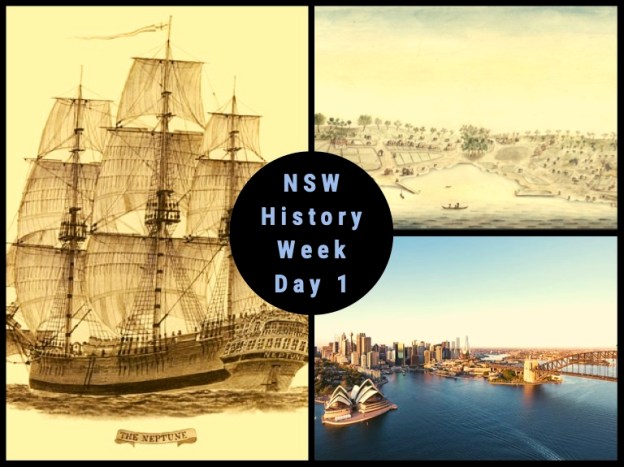
British settlement of Sydney Cove was eighteen months old, when Private Theo Feutrill, member of the newly formed New South Wales Corps, arrived in Port Jackson on the Neptune as part of the Second Fleet. At the time, Sydney Cove had a settler population of just over 1,000 people (including 736 convicts). When the six ships of the Second Fleet arrived in June 1790, the passengers (including the military and convicts) more than doubled the population number.

But before Theo arrived on the Neptune, the settlers, which arrived in 1788 (eighteen months earlier) had long been expecting to receive supplies from Great Britain. A great deal of frustration and anxiety was felt in the growing absence of ships, as supplies dwindled and precious food rations were reduced. Upon sighting the first ship to arrive since the First Fleet, on 3 June 1790, Lieutenant-Colonel David Collins wrote it was “to the inexpressible satisfaction of every heart in the settlement (that) the long-looked-for signal was made for a ship at the South Head. Every countenance was instantly cheered, and wore the lively expressions of eagerness, joy and anxiety.”

Captain Watkin Tench went a bit further in his journal: “At length the clouds of misfortune began to separate, and on the evening of the 3rd of June, the joyful cry of “the flag’s up,” resounded in every direction. I was sitting in my hut, musing on our fate, when a confused clamour in the street drew my attention. I opened my door, and saw several women with children in their arms running to and fro with distracted looks, congratulating each other, and kissing their infants with the most passionate and extravagant marks of fondness. I needed no more; but instantly started out, and ran to a hill, where, by the assistance of a pocket glass, my hopes were realized. My next door neighbour, a brother-officer, was with me; but we could not speak; we wrung each other by the hand, with eyes and hearts overflowing.”

Their joy was to be short-lived, however, to be replaced with “wonder and mortification” that the ship they saw (the Lady Juliana) contained not livestock and supplies as they had been expecting, but female convicts. The colonists soon learnt the sorry tale that a supply ship had been sent earlier, but had struck an iceberg just off the coast of South Africa. Three days after the sighting of the Lady Juliana near South Head in New South Wales, the passengers disembarked and it was “a little mortifying to find on board the first ship that arrived, a cargo so unnecessary and unprofitable as two hundred and twenty-two females, instead of a cargo of provisions.” When the women landed “many of them appeared to be loaded with the infirmities incident to old age, and to be very improper subjects for any of the purposes of an infant colony.” And “instead of being capable of labour” they appeared to be “never likely to be any other than a burthen to the settlement.”

However, the situation appeared to improve somewhat on the 20th when, at last, a storeship came in sight. The Justinian was the second ship in the Second Fleet to arrive, and it was greeted with great joy, but this welcome news was tempered as the colonists learnt “that three transports might be hourly expected, having on board (one) thousand convicts …. together with detachments of a corps raised for the service of this country.”

After the Justinian arrived, the full food ration was reinstated to be “issued weekly”, and “the drum for labour was to beat as usual in the afternoons at one o’clock.” With replenished stores, Lt.-Col. David Collins wrote: “How general was the wish that no future necessity might ever occasion another reduction of the ration, or an alteration in the labour of the people.” With our telescope looking back through the years, knowing what is ahead for these people, we realise it is a futile wish.

Nearly three weeks later, the transport ships Surpize, Neptune (with Theo Feutrill onboard) and Scarborough arrived and from that point onward, the Second Fleet was to be forever known as the worst fleet ever to arrive in Australia—and the Neptune was regarded as the worst ship of them all. As the colonists gathered to watch passengers and convicts disembarking they were in a for a shock. Lt.-Col. David Collins wrote that two hundred people arrived sick, but Capt. Watkin Tench had the number closer to five hundred. As the condition of the passengers and convicts became obvious, Lt.-Col. David Collins wrote “the west side (of Sydney Cove) afforded a scene truly distressing and miserable; upwards of thirty tents were pitched in front of the hospital (the portable one not being yet put up); all of which, as well as the adjacent huts, were filled with people, many of whom were labouring under the complicated diseases of scurvy and the dysentery, and others in the last stage of either of those terrible disorders, or yielding to the attacks of an infectious fever.”

As months passed, the devasting numbers of deaths became known. History records show if you measure passenger survival of those who sailed on the Second Fleet from the time they left England and to within eight months of arrival in Sydney, the convict mortality rate was around a shocking 40 per cent. Much outrage was expressed to the Home Secretary back in Great Britain, and contracts for convict transportation were immediately changed. The story of the Second Fleet is the subject of my blog The Scandal of the Second Fleet, which can be found on my website.

Despite the horrors passengers and convicts experienced sailing to New Holland on the Neptune, the landing of this notorious ship in Sydney Cove on 28 June 1790, began Private Theo Feutrill’s association with the land to become known as Australia. His efforts, and those who came out on the First, Second and subsequent fleets, forged a country which has been home to at least eight generations of his family.

The novel, based on Theo Feutrill’s life called More Than I Ever Had, is available from independent booksellers in Sydney and also from Amazon (link to Amazon Australia site here.)