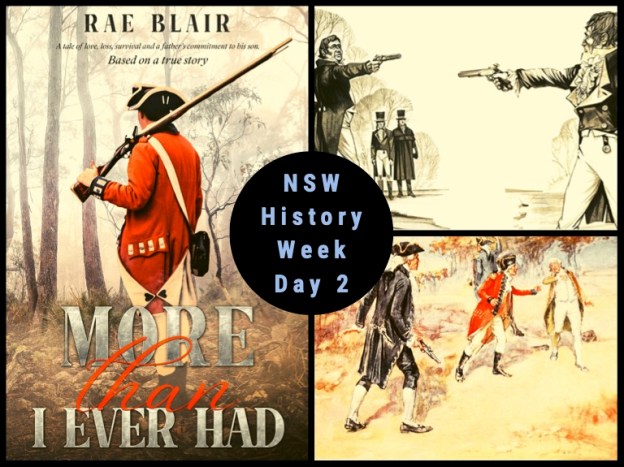
Duelling personalities: Part II
In support of NSW History Week 2022, here is part II of the second of five stories (presented in three parts) that formed the basis of my research for my novel More Than I Ever Had. This book is based on the true story of Theophilus Feutrill, who enlisted in the New South Wales Corps in 1789 in Birmingham.
Duel number two. Ross v Hill 1791. A fight for justice
Whilst this duel was fought in Sydney in December 1791, the fuse was lit in Norfolk Island. But, first, you need a bit of background on the combatants. Major Robert Ross was appointed lieutenant-governor of New South Wales in 1786 and he arrived in Sydney Cove with the First Fleet in January 1788. At the time Major Ross was the commander of the New South Marines and he had very firm views as to the establishment of the settlement—often at odds with those of Governor Phillip. Phillip endured this for over two years, but in March 1790, he saw an opportunity to remove the key source of friction from Sydney Cove, and sent Ross to take charge of Norfolk Island. Whilst this finally gave Phillip some breathing space, the British government had already decided to recall the fractious Major Ross and his New South Wales Marines, and a replacement military presence was already on its way—the New South Wales Corps—which included Private Theophilus Feutrill as part of the Second Fleet.
Now, over 1,000 miles away from Sydney Cove, Major Robert Ross was finally free to show everyone how a settlement ought to be developed. But, after the Sirius was dashed on the rocks, Ross declared martial law on the island, and removed the convicts from the government’s food stores—instead they had to grow their own food in the limited time available to them. Ross requested extra resources come to the island to ramp up development, and Captain William Hill was instructed to take a detachment of twenty-six men with him to Norfolk Island—and that included Theo Feutrill.
Once there, Captain William Hill clashed constantly with Major Ross, about the brutality of his punishments and his inhumane policies (all of which were abolished by Ross’s successor). He wrote numerous reports back to Governor Phillip. When Captain Hill and his men’s tenure was over at Norfolk Island, a replacement detachment arrived, but also onboard was a replacement for Major Ross as commandant of the Island. Captain Hill and his men boarded the Queen, as did Major Robert Ross and his second-in-command Ralph Clark (Quartermaster General and Keeper of the Stores). Whilst they awaited favourable winds to take them back to Sydney, Captain William Hill seized an opportunity to call Major Ross to account. Ralph Clark’s journal tells his side of the story:
“Wednesday, 16 November 1791
Captain Hill taken an unfair advantage of Major Ross by examining Convicts on Oath before the Revd. Mr. Johnstone and Mr. Balmain who are prejudice like himself against Major Ross fore these Said Convicts there are not greater rascals under heaven than they are and would Sell there fathers life if the[y] could get any thing by it.
Thursday 17th
The Queen in the Bay ——In her was Examined on Oath by Major Ross before Mr. Johnson and Balmain respecting a message which Mr. Hume Superintendant of the Convicts brought some time back to Major Ross from Chas. Gray Convict, which message he, Mr. Hume, said Major Ross forced him to Sign and Swear contrary to his inclination and wish, and that Mr. Faddy, Sergeant Kennedy and myself were present when he was forced ,which he informed Captain Hill and Swore Yesterday in Court —— also that he was forced when Faddy, Sergeant Kennedy and myself declared on Oath that he was not forced but on the Contrary was desired by Major Ross and myself repeatedly not to Sign or Swear to it if he did not like it or if there was any thing in it which was not as he had Related to Major Ross in the presence of Faddy and my Self —— he made answer to that there was not any thing contained but what he had Related and was perfectly Save in Signing it —— what a Rascal this Hume is.”
At this inquiry, Captain Hill had in his possession a report which was signed by a convict, Charles Gray. Gray declared under oath that Ross forced him to sign and swear the accuracy of the details in this report, which was contrary to his inclination and wish. Gray testified he was allocated to work at Queensborough, formerly known as Charlotte Field, and that he and many others made representation to (convict overseer) Mr Hume that they were not able to keep up, what they describe as ‘an impossible and punishing’ workload – a workload which had been set by Lieutenant Clark in his ambitions to complete the construction of the village.
Gray believed that word got back to Lieutenant Clark about what was said to Mr Hume, and that the Lieutenant ordered for his rations to be withheld, in punishment. But, not only his rations, but also the rations of his fellow workers, Thomas Strich and William Jones. Gray, Strich and Jones believed with no food they had no option but to leave the area to hunt for food for themselves.
Gray and Jones returned the same night, but Thomas Strich remained absent. Gray became a targeted man. On 23 May, a convict called James Thompson was cutting down a pine tree, when it fell onto him and broke his leg. Mr Gray and another convict, Michael Dennison, who were working nearby, attended to Mr Thompson, and carried him to the hospital for treatment. Lieutenant Clark punished Gray and Dennison’s absence with 200 lashes for Mr Gray and 25 for Mr Dennison. Then, on a further occasion, in October, Mr Gray received another 100 lashes for disobedience of orders and neglect of duty. It was at this point that Mr Gray lodged a formal complaint against Lieutenant Clark to Mr Hume—the basis of which that he had been singled out for special attention and unfairly punished.
Thomas Strich decided to return in June 1791. The reason for not punishing Strich upon his return was that Major Ross considered that the trouble and hardship Strich must have suffered in mind and body from the weather when he was away, and want of clothes, was a sufficient punishment for him in running away. Major Ross had forgiven him his crimes. At the inquiry, Captain Hill suggested that Major Ross struck a deal with Strich, that he would be saved the lash, if he informed on his fellow convicts.
Captain Hill suggested that when Mr Hume came to Major Ross with the formal complaint from Charles Gray, Ross called Gray to his office. As Gray could not read or write, Ross called Lieutenant Clark into his office, and Ross dictated Gray’s complaint for Clark to write down. Although, what Ross had Clark write down, put a different view on the complaint, and put both Ross and Lieutenant Clark in a more favourable light. Gray was then forced to swear to the accuracy of the report and sign it.
Clark said that he and Major Ross told Gray not to sign or swear to the report if he did not like what was said, or if there was anything in it which was not as he had related to Major Ross. Before Gray signed the report, Ross also called Lieutenant William Faddy into the room—a lieutenant with a reputation that the convicts fear. Gray felt he had no option but to sign the document Ross and Clark had constructed.
Ross was furious with Captain Hill’s interference, and saw it as an attempt to besmirch his reputation. He challenged Hill to a duel upon their return to Sydney Cove. Captain Hill received a message on 11 December 1791 which read:
0600 tmrw. Field nth of Marine Camp. Bring a 2nd. signed by Major R. Ross.
Following is a deleted scene of the duel from More Than I Ever Had, which I couldn’t fit into the printed version:
On 12 December 1791, Major Robert Ross and Captain William Hill—accompanied by their seconds and an impartial observer—gathered in the field just north of the Marine Camp at 6:00 am. Theo and James Bannister stood in amongst the other onlookers. Theo hadn’t slept, tossing in his cot with worry for his captain. William Douglas joined them, hair askew from his pillow.
The crowd shared low, expectant chatter as to the outcome. The air was still, and the odour of the men mixed with the fresh eucalypt from the bush. Grass crunched under foot, bone dry from lack of rain. The sun had already risen in a clear blue sky, and the trees were alive with birds busy finding their breakfasts. A kookaburra laughed.
Captain Hill and his second stood apart from the onlookers. If the captain was nervous, he didn’t show it. His second wiped down the pistol and checked it again.
Standing with his second, at the opposite end of the field to Captain Hill, Major Ross took a swig from a hip flask. The major’s second had his head bent over the task of preparing the pistol; the process more elaborate than the preparation undertaken for Captain Hill’s. Theo chewed his lip, and despite the early morning being warm, he shivered.
The seconds had already measured and marked out the ground showing at which point Ross and Hill would stand—at a distance opposite and facing each other. Ross and Hill checked their pistols, walked to their appointed places and waited. Their eyes locked on each other. Arms by their sides. Whilst Hill appeared calm but determined, Ross’s face coloured with hatred. Theo wanted to look away.
The independent observer held aloft a handkerchief for a moment before it fluttered from his grip. At this signal, Ross and Hill raised their pistols and stepped toward each other.
Theo’s fingernails dug into his palms.
Ross fired first. A misfire! Theo flinched at the dull click. His eyes darted from Ross to Hill, flooded with relief the captain was spared. Hill moved his aim left of Major Ross and fired. Surprised murmurs came from the crowd. Many disappointed to be denied the blood they’d hoped to see, but for Theo he couldn’t be happier.
Major Ross, his face now drained white, recovered his composure and drew himself to full height.
“I am satisfied,” he said, before striding off with his second in close pursuit.
**
‘More Than I Ever Had’ based on the true story of Theophilus Feutrill is available from independent booksellers in Sydney and from Amazon. Link to Amazon Australia site here.
 Rae Blair