Tag Archives: Neptune

NSW History Week – Day 2

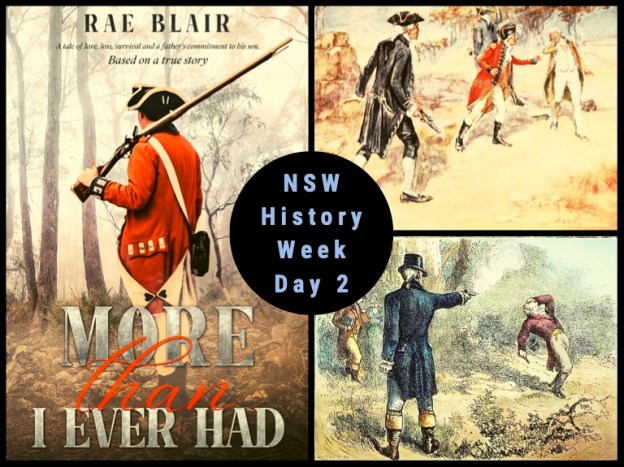
Duelling personalities: Part I

In support of NSW History Week 2022, here is the second of five stories (presented in three parts) that formed the basis of my research for my novel More Than I Ever Had. This book is based on the true story of Theophilus Feutrill, who enlisted in the New South Wales Corps in 1789 in Birmingham.

In eighteenth century England, duelling—that is an arranged shooting between two people for the sake of honour—was against the law, and to kill in the course of a duel was judged as murder. However, it was widely practiced by the male members of ‘nobility’ and the upper classes where one’s honour needed to be restored. The conduct of a duel is at the combatant’s discretion and mutal agreement—they could stand back to back and walk ten paces and turn and shoot; they could start at opposite ends of a clearing and walk towards each other with pistols held in arms outstretched and shoot, or they could stand at a prescribed distance and toss for who gets to shoot first. A constant requirement is that the combatants must have seconds, whose job it is to load the pistols, and confer with each other as representatives of the combatants. A neutral person makes a signal for the duel to commence.

In Bilston, the west-midlands of England, where Theo was raised in the mining and manufacturing community, he would not have witnessed any duels. But he didn’t have to wait long after he boarded the Neptune to watch his first. In fact, the Neptune hadn’t even left English waters before tempers spilled over and someone’s ‘honour’ needed to be restored. And, there were at least two more held in Sydney in the very early days of settlement, one involving the ambitious and fiery John Macarthur (he was also involved in the first one), and one involving Theo’s captain, Captain William Hill.

Duel number one: Macarthur v Gilbert 1789. Tempers on board

Ambitious and newly promoted, Lieutenant John Macarthur boarded the Neptune, with his wife and young son, to sail to New South Wales as part of the NSW Corps. As the ship pulled away from Woolwich Wharf, he, and other members of the military, soon realised they had no status on the ship, being under the complete control of the ship’s captain, Captain Thomas Gilbert, and his crew. And, worse, Captain Gilbert and his crew had little regard for the comfort and welfare of the passengers. Macarthur’s bitter complaints to the captain about the quarters provided to him and his family were disregarded, which led to a blazing confrontation. The Sydney Morning Herald published an article, in February 1945, which recounted the following story:

“The casus belli between Macarthur and John (sic) Gilbert, the captain of the ship, arose from the former’s complaints regarding the location and fittings of his cabin, and ‘the stench of the buckets belonging to the convict women of a’morning.’ Gilbert threatened to write to the War Office and have Macarthur and his wife turned out of the ship. Gilbert gave Macarthur a punch on the breast. Nepean interfered and patched up the quarrel temporarily…..On the seven days trip round to Plymouth there was another flare-up, Macarthur accusing the captain of ungentlemanly conduct towards himself and his wife, and calling him publicly on the quarter-deck—he had a fine capacity for vituperation—‘a great scoundrel’. In retaliation, Gilbert told Macarthur that he had ‘settled many a greater man than him’, and that he was to be seen on shore, whereupon Macarthur named 4 o’clock at the Fountain Tavern, Plymouth Docks. They met, a duel was fought—apparently a bloodless one—honour was satisfied and both parties agreed to live in harmony thereafter.”

Theo and his brother soldiers would have gathered nearby to watch the duel, hoping ‘their’ Macarthur would prevail, but wondering whether they were about to witness someone being shot dead.

Despite Macarthur and Gilbert declaring a truce, the harmony was not to last, with both parties continuing to quarrel. Whilst the ship was laying over at Plymouth, Captain Nicholas Nepean took the opportunity to write to his brother Evan Nepean who was Under Secretary of State in the Home Department, complaining about the ship’s captain. By the time the ship docked at Portsmouth, a replacement for Captain Gilbert was waiting. Whilst the replacement captain was a welcome sight for all on board, he proved to be even more heartless, causing Elizabeth Macarthur to write in her diary that Captain Gilbert was a “perfect sea-monster.” The situation onboard became intolerable for the Macarthur family to the point where they arranged to be transferred mid-ocean to the Scarborough. Theo wasn’t as fortunate.

**

‘More Than I Ever Had’ based on the true story of Theophilus Feutrill is available through independent booksellers in Sydney and from Amazon. Link to Amazon Australia site here.
NSW History Week 2022 – Day 1

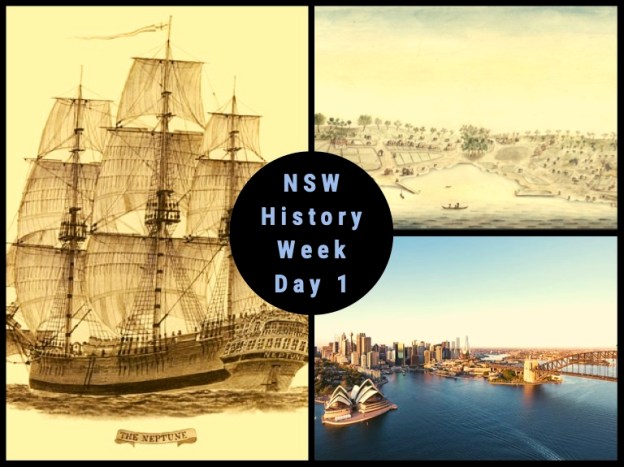
The Arrival of the Second Fleet

In support of NSW History Week 2022, I will share five stories that formed the basis of my research for my novel More Than I Ever Had. This book is based on the true story of Theophilus Feutrill, who enlisted in the New South Wales Corps in 1789 in Birmingham.

British settlement of Sydney Cove was eighteen months old, when Private Theo Feutrill, member of the newly formed New South Wales Corps, arrived in Port Jackson on the Neptune as part of the Second Fleet. At the time, Sydney Cove had a settler population of just over 1,000 people (including 736 convicts). When the six ships of the Second Fleet arrived in June 1790, the passengers (including the military and convicts) more than doubled the population number.

But before Theo arrived on the Neptune, the settlers, which arrived in 1788 (eighteen months earlier) had long been expecting to receive supplies from Great Britain. A great deal of frustration and anxiety was felt in the growing absence of ships, as supplies dwindled and precious food rations were reduced. Upon sighting the first ship to arrive since the First Fleet, on 3 June 1790, Lieutenant-Colonel David Collins wrote it was “to the inexpressible satisfaction of every heart in the settlement (that) the long-looked-for signal was made for a ship at the South Head. Every countenance was instantly cheered, and wore the lively expressions of eagerness, joy and anxiety.”

Captain Watkin Tench went a bit further in his journal: “At length the clouds of misfortune began to separate, and on the evening of the 3rd of June, the joyful cry of “the flag’s up,” resounded in every direction. I was sitting in my hut, musing on our fate, when a confused clamour in the street drew my attention. I opened my door, and saw several women with children in their arms running to and fro with distracted looks, congratulating each other, and kissing their infants with the most passionate and extravagant marks of fondness. I needed no more; but instantly started out, and ran to a hill, where, by the assistance of a pocket glass, my hopes were realized. My next door neighbour, a brother-officer, was with me; but we could not speak; we wrung each other by the hand, with eyes and hearts overflowing.”

Their joy was to be short-lived, however, to be replaced with “wonder and mortification” that the ship they saw (the Lady Juliana) contained not livestock and supplies as they had been expecting, but female convicts. The colonists soon learnt the sorry tale that a supply ship had been sent earlier, but had struck an iceberg just off the coast of South Africa. Three days after the sighting of the Lady Juliana near South Head in New South Wales, the passengers disembarked and it was “a little mortifying to find on board the first ship that arrived, a cargo so unnecessary and unprofitable as two hundred and twenty-two females, instead of a cargo of provisions.” When the women landed “many of them appeared to be loaded with the infirmities incident to old age, and to be very improper subjects for any of the purposes of an infant colony.” And “instead of being capable of labour” they appeared to be “never likely to be any other than a burthen to the settlement.”

However, the situation appeared to improve somewhat on the 20th when, at last, a storeship came in sight. The Justinian was the second ship in the Second Fleet to arrive, and it was greeted with great joy, but this welcome news was tempered as the colonists learnt “that three transports might be hourly expected, having on board (one) thousand convicts …. together with detachments of a corps raised for the service of this country.”

After the Justinian arrived, the full food ration was reinstated to be “issued weekly”, and “the drum for labour was to beat as usual in the afternoons at one o’clock.” With replenished stores, Lt.-Col. David Collins wrote: “How general was the wish that no future necessity might ever occasion another reduction of the ration, or an alteration in the labour of the people.” With our telescope looking back through the years, knowing what is ahead for these people, we realise it is a futile wish.

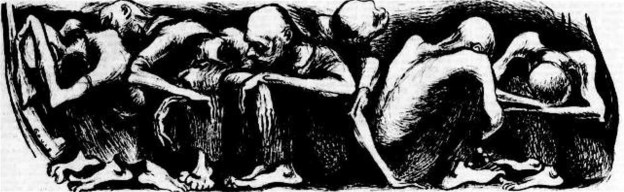
Nearly three weeks later, the transport ships Surpize, Neptune (with Theo Feutrill onboard) and Scarborough arrived and from that point onward, the Second Fleet was to be forever known as the worst fleet ever to arrive in Australia—and the Neptune was regarded as the worst ship of them all. As the colonists gathered to watch passengers and convicts disembarking they were in a for a shock. Lt.-Col. David Collins wrote that two hundred people arrived sick, but Capt. Watkin Tench had the number closer to five hundred. As the condition of the passengers and convicts became obvious, Lt.-Col. David Collins wrote “the west side (of Sydney Cove) afforded a scene truly distressing and miserable; upwards of thirty tents were pitched in front of the hospital (the portable one not being yet put up); all of which, as well as the adjacent huts, were filled with people, many of whom were labouring under the complicated diseases of scurvy and the dysentery, and others in the last stage of either of those terrible disorders, or yielding to the attacks of an infectious fever.”

As months passed, the devasting numbers of deaths became known. History records show if you measure passenger survival of those who sailed on the Second Fleet from the time they left England and to within eight months of arrival in Sydney, the convict mortality rate was around a shocking 40 per cent. Much outrage was expressed to the Home Secretary back in Great Britain, and contracts for convict transportation were immediately changed. The story of the Second Fleet is the subject of my blog The Scandal of the Second Fleet, which can be found on my website.

Despite the horrors passengers and convicts experienced sailing to New Holland on the Neptune, the landing of this notorious ship in Sydney Cove on 28 June 1790, began Private Theo Feutrill’s association with the land to become known as Australia. His efforts, and those who came out on the First, Second and subsequent fleets, forged a country which has been home to at least eight generations of his family.

The novel, based on Theo Feutrill’s life called More Than I Ever Had, is available from independent booksellers in Sydney and also from Amazon (link to Amazon Australia site here.)

The scandal of the Second Fleet

So much is known about the First Fleet that sailed to Botany Bay in 1788. But, less is known about the Second Fleet that followed it two-and-a-half-years later. My novel More than I ever had, tells the real life story of Theo Feutrill, a young Englishman who enlists in the New South Wales Corps in Birmingham, and is allocated a berth onboard the Neptune to sail to Sydney Cove as part of the Second Fleet. The Second Fleet became notorious for a reason, and when Theo steps onboard has no idea what’s ahead of him.

*

Why was there even a First Fleet?

When America said a polite ‘no thank you, not any more’ to the British, refusing to take further convicts on their shores (I think the American War of Independence had something to do with it) Britain ceased transportation of its convicts from 1776 to 1788. As a result, the prison population in Britain swelled. Rather than overhaul the crime and punishment system, authorities made the disastrous decision to house prisoners in ship hulks anchored in rivers and along sheltered coastlines. Disease was rampant, and conditions so bad, about a third of the prisoners died. Something had to be done.

In 1783, the idea of using Botany Bay as the new penal colony was proposed, and by May 1787 a fleet of ships, the First Fleet, led by Governor Arthur Phillip, sailed from Portsmouth and arrived in Botany Bay on 18 January 1788. This fleet of eleven ships contained six convict transports carrying 751 convicts—but unfortunately it did little to alleviate the over-crowded conditions on the prison hulks.

Once word was received from Governor Phillip that the First Fleet arrived and a colony was in the process of being established, the decision was made to send a Second Fleet.

While the First Fleet had a low mortality rate (5.4%), it was very expensive at £55,000. The ships contractor, William Richards, was a humanitarian and devout Christian, so he ensured the ships stopped often and were well supplied. To make savings for the Second Fleet, the government put the contract out to tender for three ships to transport prisoners to Sydney Cove. After the bidding process, the lowest bid was accepted (less than half of the cost of the First Fleet). William Richards was unsuccessful in his bid, instead the contract was awarded to Camden, Calvert & King—the largest company in London involved in the slave trade. What could go wrong?

Camden, Calvert & King were contracted to supply three ships (Scarborough, Suprize, and Neptune) and would receive £17.7.6 for each convict embarked. They also had the ability to sell any left-over provisions at Sydney Cove. Also, in the contract, the ship’s captains had full control over their ships, the doling out of provisions, and the treatment of the convicts. Perhaps in the hands of a different contractor, this contract could have worked to the benefit of all. But the masters on these ships were later described as: low-lifed and barbarous.

Through a dispute with the military onboard the Neptune, its master was replaced before the ship even left English waters, and in his stead was a man later described as a demented sadist and by Elizabeth Macarthur as a perfect sea-monster.

To make up the Second Fleet, the three Camden, Calvert & King prisoner transport ships were joined by Justinian (storeship), naval warship Guardian (primarily transporting stores but scuttled by an iceberg near South Africa) and Lady Juliana (contracted by William Richards, which transported exclusively female convicts).

A naval agent was appointed to monitor the captain and crew of contracted ships, but the one appointed to monitor Camden, Calvert & King’s ships did a questionable job. The master of the Guardian wrote later:

…if ever the navy make another contract like that of the last three ships they ought be shot, and as for their agent Mr Shapcote he behaved here just as foolishly as a man could well do.

Captain William Hill who travelled on Suprize with half of his men (the other half were on Neptune) wrote after his voyage:

The slave trade is merciful compared with what I have seen in this fleet.

So, we have ship masters of dubious character who have full control over provisions and how the convicts are treated. The contracting company is paid a set fee whether the convicts arrive alive or not, and there’s an incentive to not only withhold supplies from both convicts and passengers but to have less mouths to feed, as the captain and crew were set for financial gain by selling the left-over provisions when they arrived at the new colony.

Of the nearly 1,000 convicts onboard the Second Fleet, 261 male and 16 female convicts died on the voyage (plus four children) and another 150 convicts were dead within months of their arrival in the colony. In other words, if you measure survival within eight months of arrival in Sydney, the mortality rate of Second Fleet convicts was around 40 per cent. Compare the death rates by ship:

  • Lady Juliana (5 women, 2 children)
  • Suprize (42 men)
  • Scarborough (68 men)
  • Neptune (151 men, 11 women and 2 children)

The shocking mortality rate of the Second Fleet was nearly ten times that of the First Fleet voyage, and Theo Feutrill—the main protagonist in my book—is right in the thick of it as a passenger onboard the Neptune.

Following the outrage that occurred after the Second Fleet ships landed at Sydney Cove, the British government changed the way it contracted transport ships in the future. Amongst other things, contractors were paid for each convict that arrived in Sydney Cove alive.

*

More than I ever had More Than I Ever Had is a novel based on a true story by Rae Blair, and is available world-wide on Amazon Kindle in eBook and paperback formats.

Sharing advance chapters of More than I ever had

I think 2020 has taught us a lot about resilience and flexibility. Here, on the Northern Beaches of Sydney, our growth as humans continue to be challenged, as we face potential restrictions around Christmas celebrations this year. Already, our plans to be in Melbourne to celebrate with family have been dashed. I dislike the hackneyed word ‘pivot’, so instead I’ll use ‘pirouette’ to describe the fancy footwork we’ve all needed to learn to negotiate our forward planning.

One good thing about being ‘locked down’ for a few days, is that it’s given me time to finish the editing of the early chapters of my draft manuscript, which is based on the life of ancestor Theophilus Feutrill. This historical fiction* is tentatively called More than I ever had, and tells the story of his journey to New South Wales as a soldier with the New South Wales Corps in 1790, and the next 30 years of his life.

Using feedback from writers’ groups and some early readers of my manuscript, I’ve been able to enrich the way the story is told. As so many of you, who are following my (ahem, irregular) blogs, have expressed a desire to read the manuscript, I’d like to now share the first three chapters with you. Hope you enjoy the writing, and feel free to share with me thoughts and comments after you’ve read the chapters.

My aim for the rest of the year is to complete the editing of the entire manuscript, and start 2021 seeking an agent or a publisher, so I can share Theo’s story with a wider audience.

Below is the ‘back cover’ blurb for the manuscript, and links you need to access the first two chapters. Happy reading, and hope you all have a safe and happy festive season.

*While the book is a work of fiction, it is based very closely on the facts of the life of Theophilus Feutrill, set within real events in Australian colonial history. Feutrill family historians will notice that Ann Short’s name has been changed to Ellen Short to avoid reader confusion.

Blurb for More than I ever had by Rae Blair

Faced with limited options in working class 18th century England, will leaving behind everything he ever knew give Theo the life and happiness he’s been long denied?

After a fire destroys 18-year-old Theophilus Feutrill’s employment prospects, and running from gambling debts, he enlists with the New South Wales Corps in Birmingham in 1789. He sails to the new penal colony on the worst ship in the worst fleet ever to reach Sydney Cove.

Theo contributes to the establishment of the colony, and falls in love with Irish convict, Ellen Short. Together, they deal with the struggles of a penal colony and fledgling country, facing famine and hardship. Theo is challenged with a devastating loss, before his duty takes him to establish northern Van Diemen’s Land.

Despite long periods of famine, his family grows, as does his reputation for the capture of bushrangers, which leads him to an encounter with the notorious Michael Howe.

Then Theo must make a choice between his son and his family, and the path he chooses forces him to confront his most heartbreaking loss of all.

This story is based on the real life of Theophilus Feutrill, a rank-and-file soldier with the British military, who came to New South Wales on the Second Fleet. As a soldier, his tale is unique and breathes new life into the colonial Australian story and encourages us to consider the true cost of loyalty, family and duty.

How to access the first three chapters

1) Download the Issuu App:

Android users:

Apple users:

https://apps.apple.com/app/apple-store/id914453825?mt=8

2) Then, click this link to access the first three chapters:

https://issuu.com/raeblairwriter/docs/blog_post__7_more_than_i_ever_had_chpt_1_and_2

Going beyond simple details

I’ve often wondered why some people—me for instance—become obsessed with tracing their family tree, and other people have zero interest. Take my brother, for example. I’ll unearth some tantalising snippet about our family tree and send out a group message to our family. Some members of my family will share my excitement, but for my brother, it won’t raise a skerrick of curiosity.

He says, “What difference does knowing all of that make to my life right now?”

I understand this position—unless I dig up a long lost wealthy relative who’s looking to leave their money to a family member.

But I view it a different way. I believe that who we are is a combination of nurture and nature.

Regarding ‘nurture’—in your Genealogical Tree are the names of every one of your ancestors who had a child, who had a child, etc. that led to you. It is not unreasonable to suggest that every decision made by these ancestors contributed to who you are today.

Regarding ‘nature’—it is less clear whether a particular ancestor in your Genealogical Tree has any biological contribution to you (or what the extent of their influence is), because of the random nature of DNA inheritance—though some geneticists suggest that there is a very high likelihood that you will have inherited some DNA from ancestors 9 x removed from you. That’s an enticing thought. At this stage, however, it is not possible to map your Genetic Tree to know for sure who is in it, but it is only a matter of time.

A few years ago, one of my husband’s aunts showed me a thick book with a red cover and gold embossed title. This tome chronicled the details of the life and offspring of Theophilus Fewtrell—my husband’s 4x great-grandfather, and by extension, my sons’ and grandson’s 5x and 6x great-grandfather. Whilst the research was impressive and the details extensive, there were many questions unanswered; for example, why did he make the decisions he made–which impacted on his family and his descendants’ lives? If I was to gain a sense of what the details of Theophilus Fewtrell’s life might mean to my family, I needed to understand him on a deeper level.

His story, as laid out in The Feutrill Saga book, and later confirmed by my research, hooked me. Here was an 18-year-old English boy, orphaned from age 3, who signs up to be a member of the New South Wales Corps in 1789 and sails to the other side of the world. Theo’s enlistment sees him serving in three continents and thrusts him amongst the struggles of a fledgling country, dealing with famine and other hardships. His is a story of love and loss and an impossible decision that leads to devastating consequences.

Theo’s life details are compelling, but a hypothesis was needed for his motivations and decisions, in the context of early Australia and the British military in the late 18th/early 19th centuries.

This was my inspiration to finally write a novel–to create a work of fiction based on facts and really get to the bottom of Theo’s story. In March 2019, I set down my first words.

Having worked in marketing, corporate communications and editing, gave me the confidence to start the manuscript, but it was soon apparent that corporate and creative writing are different disciplines. If the story was to be told well, I had to gain new skills.

The next 18 months saw my immersion in learning the creative writing discipline. Apart from a creative writing course and joining a Writers’ Guild run by a successful US novelist, I read blogs about structure, dialogue, character development and the business of publishing, and downloaded writers’ resources. The back catalogue of a writer’s podcast ran in my car. The local writer’s group accepted my membership, and I’m soon to start group coaching with a UK-based historical writer’s organisation.

To connect further with the writer and reader communities, I established my ‘writer’s’ website (www.raeblair.com) and online presence on Instagram (RaeJBlairWriter) and Twitter (@RaeJBlairWriter).

Running alongside all of this was the research, which formed the backbone of my hypotheses regarding Theo’s life decisions. Accessing journals of people who passed Theo in the street or who were passengers on the same ship over from England, and even letters written by people in Theo’s regiments, brought his world to life. There were academic theses about bushrangers and Australia’s security, and diaries of doctors who treated illnesses of the era, which added context, and these were just a few of the sources that contributed to my understanding.

And each day, the learning and the research fuelled the words that formed the story.

After 18 months, the novel has a beginning, a middle and an end, and is (from my viewpoint) a cohesive work of fiction. It has the working title of ‘More than I ever had’. The manuscript is now being read by a handful of people from diverse backgrounds who will provide me with critical feedback. This input will help take the novel to the next level, when it should be ready then to submit to potential publishers.

I’ll let you know how it progresses!