I think 2020 has taught us a lot about resilience and flexibility. Here, on the Northern Beaches of Sydney, our growth as humans continue to be challenged, as we face potential restrictions around Christmas celebrations this year. Already, our plans to be in Melbourne to celebrate with family have been dashed. I dislike the hackneyed word ‘pivot’, so instead I’ll use ‘pirouette’ to describe the fancy footwork we’ve all needed to learn to negotiate our forward planning.
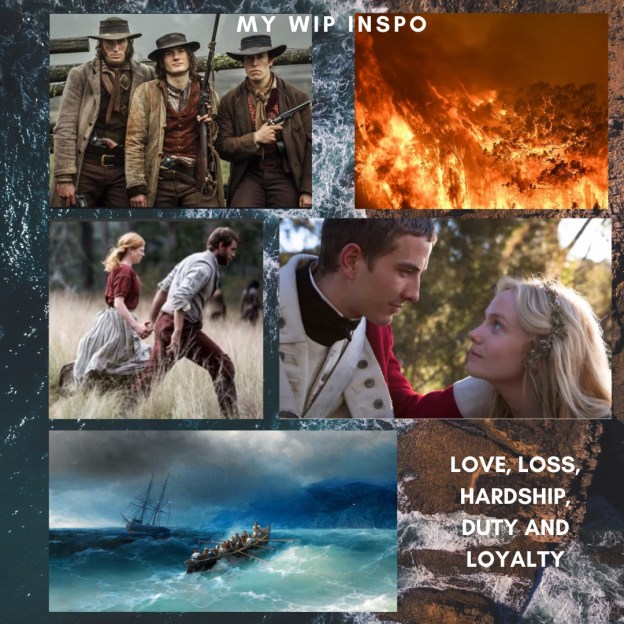
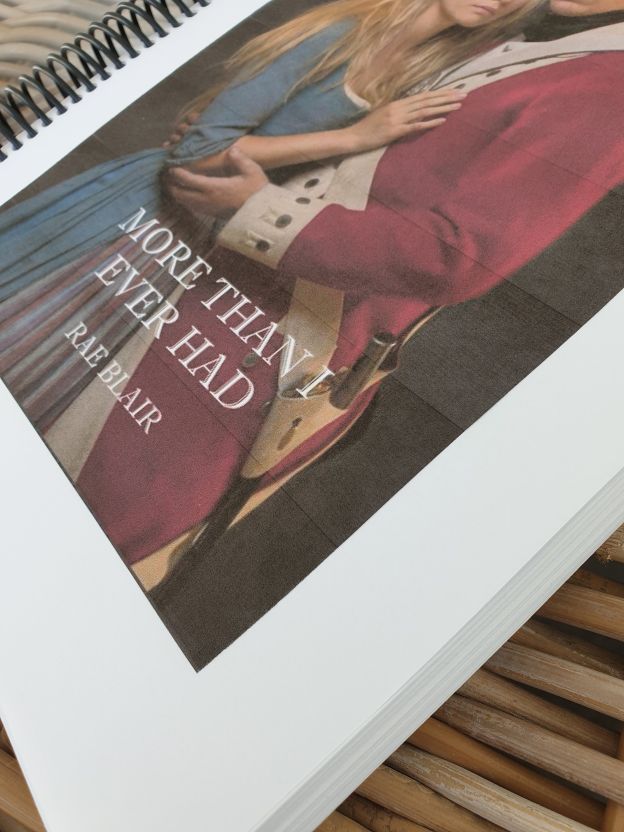
One good thing about being ‘locked down’ for a few days, is that it’s given me time to finish the editing of the early chapters of my draft manuscript, which is based on the life of ancestor Theophilus Feutrill. This historical fiction* is tentatively called More than I ever had, and tells the story of his journey to New South Wales as a soldier with the New South Wales Corps in 1790, and the next 30 years of his life.
Using feedback from writers’ groups and some early readers of my manuscript, I’ve been able to enrich the way the story is told. As so many of you, who are following my (ahem, irregular) blogs, have expressed a desire to read the manuscript, I’d like to now share the first three chapters with you. Hope you enjoy the writing, and feel free to share with me thoughts and comments after you’ve read the chapters.
My aim for the rest of the year is to complete the editing of the entire manuscript, and start 2021 seeking an agent or a publisher, so I can share Theo’s story with a wider audience.
Below is the ‘back cover’ blurb for the manuscript, and links you need to access the first two chapters. Happy reading, and hope you all have a safe and happy festive season.
*While the book is a work of fiction, it is based very closely on the facts of the life of Theophilus Feutrill, set within real events in Australian colonial history. Feutrill family historians will notice that Ann Short’s name has been changed to Ellen Short to avoid reader confusion.
Blurb for More than I ever had by Rae Blair
Faced with limited options in working class 18th century England, will leaving behind everything he ever knew give Theo the life and happiness he’s been long denied?
After a fire destroys 18-year-old Theophilus Feutrill’s employment prospects, and running from gambling debts, he enlists with the New South Wales Corps in Birmingham in 1789. He sails to the new penal colony on the worst ship in the worst fleet ever to reach Sydney Cove.
Theo contributes to the establishment of the colony, and falls in love with Irish convict, Ellen Short. Together, they deal with the struggles of a penal colony and fledgling country, facing famine and hardship. Theo is challenged with a devastating loss, before his duty takes him to establish northern Van Diemen’s Land.
Despite long periods of famine, his family grows, as does his reputation for the capture of bushrangers, which leads him to an encounter with the notorious Michael Howe.
Then Theo must make a choice between his son and his family, and the path he chooses forces him to confront his most heartbreaking loss of all.
This story is based on the real life of Theophilus Feutrill, a rank-and-file soldier with the British military, who came to New South Wales on the Second Fleet. As a soldier, his tale is unique and breathes new life into the colonial Australian story and encourages us to consider the true cost of loyalty, family and duty.
I’ve often wondered why some people—me for instance—become obsessed with tracing their family tree, and other people have zero interest. Take my brother, for example. I’ll unearth some tantalising snippet about our family tree and send out a group message to our family. Some members of my family will share my excitement, but for my brother, it won’t raise a skerrick of curiosity.
He says, “What difference does knowing all of that make to my life right now?”
I understand this position—unless I dig up a long lost wealthy relative who’s looking to leave their money to a family member.
But I view it a different way. I believe that who we are is a combination of nurture and nature.
Regarding ‘nurture’—in your Genealogical Tree are the names of every one of your ancestors who had a child, who had a child, etc. that led to you. It is not unreasonable to suggest that every decision made by these ancestors contributed to who you are today.
Regarding ‘nature’—it is less clear whether a particular ancestor in your Genealogical Tree has any biological contribution to you (or what the extent of their influence is), because of the random nature of DNA inheritance—though some geneticists suggest that there is a very high likelihood that you will have inherited some DNA from ancestors 9 x removed from you. That’s an enticing thought. At this stage, however, it is not possible to map your Genetic Tree to know for sure who is in it, but it is only a matter of time.
A few years ago, one of my husband’s aunts showed me a thick book with a red cover and gold embossed title. This tome chronicled the details of the life and offspring of Theophilus Fewtrell—my husband’s 4x great-grandfather, and by extension, my sons’ and grandson’s 5x and 6x great-grandfather. Whilst the research was impressive and the details extensive, there were many questions unanswered; for example, why did he make the decisions he made–which impacted on his family and his descendants’ lives? If I was to gain a sense of what the details of Theophilus Fewtrell’s life might mean to my family, I needed to understand him on a deeper level.
His story, as laid out in The Feutrill Saga book, and later confirmed by my research, hooked me. Here was an 18-year-old English boy, orphaned from age 3, who signs up to be a member of the New South Wales Corps in 1789 and sails to the other side of the world. Theo’s enlistment sees him serving in three continents and thrusts him amongst the struggles of a fledgling country, dealing with famine and other hardships. His is a story of love and loss and an impossible decision that leads to devastating consequences.
Theo’s life details are compelling, but a hypothesis was needed for his motivations and decisions, in the context of early Australia and the British military in the late 18th/early 19th centuries.
This was my inspiration to finally write a novel–to create a work of fiction based on facts and really get to the bottom of Theo’s story. In March 2019, I set down my first words.
Having worked in marketing, corporate communications and editing, gave me the confidence to start the manuscript, but it was soon apparent that corporate and creative writing are different disciplines. If the story was to be told well, I had to gain new skills.
The next 18 months saw my immersion in learning the creative writing discipline. Apart from a creative writing course and joining a Writers’ Guild run by a successful US novelist, I read blogs about structure, dialogue, character development and the business of publishing, and downloaded writers’ resources. The back catalogue of a writer’s podcast ran in my car. The local writer’s group accepted my membership, and I’m soon to start group coaching with a UK-based historical writer’s organisation.
To connect further with the writer and reader communities, I established my ‘writer’s’ website (www.raeblair.com) and online presence on Instagram (RaeJBlairWriter) and Twitter (@RaeJBlairWriter).
Running alongside all of this was the research, which formed the backbone of my hypotheses regarding Theo’s life decisions. Accessing journals of people who passed Theo in the street or who were passengers on the same ship over from England, and even letters written by people in Theo’s regiments, brought his world to life. There were academic theses about bushrangers and Australia’s security, and diaries of doctors who treated illnesses of the era, which added context, and these were just a few of the sources that contributed to my understanding.
And each day, the learning and the research fuelled the words that formed the story.
After 18 months, the novel has a beginning, a middle and an end, and is (from my viewpoint) a cohesive work of fiction. It has the working title of ‘More than I ever had’. The manuscript is now being read by a handful of people from diverse backgrounds who will provide me with critical feedback. This input will help take the novel to the next level, when it should be ready then to submit to potential publishers.
If this is the first of my posts you are reading, then I suggest you go back to Part I and read the posts in sequence.
A major roadblock stood in the way of my identifying the parents of my 2x Great-Grandfather, John Willington Jackson. I had his government-issued death certificate, which listed his parents as John Jackson and Elizabeth Willington. But a tip from a member of the Ancestry.com community pointed me to the Will* of an Irishman called William Jackson, whose son was John Willington Jackson (living in Melbourne, where my John Willington Jackson lived).
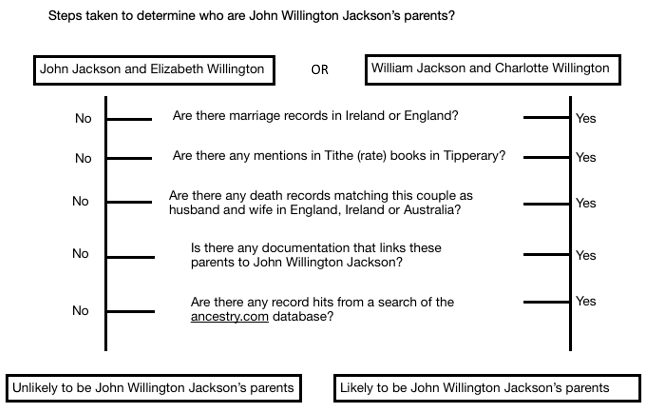
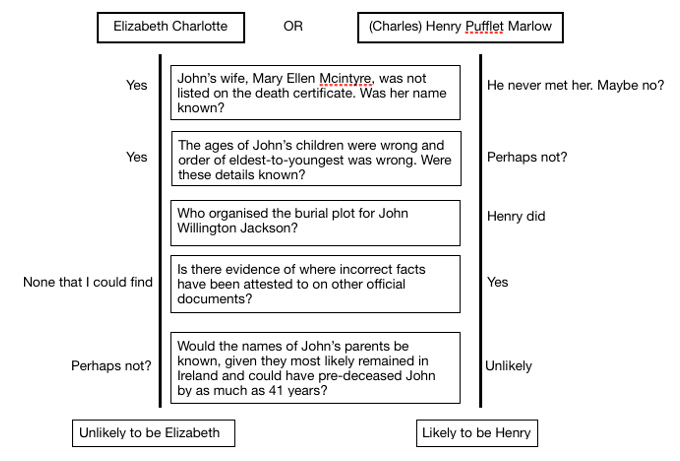
This set in motion many weeks of research to uncover who were the parents of my 2x Great-Grandfather. I couldn’t accept any of the information on face value. I needed supported facts as I didn’t want future hours of work built upon incorrect information. Below are two flow charts which summarise how I determined the true identity of John Willington Jackson’s parents. The flow charts are followed by dot points giving specific details of the research undertaken. I also consider the possibility of whether there might have been two men called John Willington Jackson, and what I do next.
Why would the information on John Willington Jackson’s death certificate be wrong?
Was it because the person who provided it didn’t know the information / or didn’t care if the information was correct?
We know he was living with his daughter, Elizabeth, and son-in-law, (Charles) Henry Marlow at the time of his death, so it is logical to assume it was either Elizabeth or Henry who provided the information. By determining who provided the information for the death certificate, we might be able to gain some insight as to why the information was wrong.
So, I am of the opinion that John Willington Jackson’s son-in-law provided the information for the death certificate and the information he provided was assumed and wrong. I’m also of the opinion that John Willington Jackson’s parents are William and Charlotte Jackson of Tipperary. Below are the specific steps I took to support my assumptions.
(1) Are John and Elizabeth (Willington) Jackson the parents?
1.1 Through a manual search of Irish and English records, I could not locate a John Jackson (born around 1800) marrying an Elizabeth Willington. There were plenty of men called John Jackson born around that time who married an Elizabeth, but none of these women were from the Willington family. I also found Elizabeth Willingtons in England, but none in Ireland.
1.2 I could not locate any death records for a John Jackson who was the husband of Elizabeth Willington, and vice versa, in England, Ireland or Australia.
1.3 John Willington Jackson’s occupation was an engineer. His occupation would have been the result of an excellent education, provided by a family with resources. Families with resources either owned or rented land for farming, and their details appeared in Tithe books. The name of John Jackson (Snr) doesn’t appear in the Tithe books.
1.4 I entered the names of John Jackson and Elizabeth Willington as John Willington Jackson’s parents into my Ancestry.com family tree. This data combination of parents and child did not return any records from the automatic cross-reference of the Ancestry.com databases.
(2) Establishing the source of John Willington Jackson’s death certificate information.
2.1 Census records show John Willington Jackson was living with his eldest daughter and husband in 1903—occupation listed as ‘Engineer’. The occupation detail aligns with information recorded on his son’s death certificate (William). If John was living with his daughter and son-in-law at the time of his death, then it is logical to assume that one of them provided the death certificate information, as his other children remained living in Victoria.
2.2 Karrakatta Cemetery in Perth is John Willington Jackson’s place of burial. Upon obtaining a copy of his burial record from the cemetery, I found this was arranged by his son-in-law, Charles Henry Pufflett Marlow—known as Henry. Therefore, it is probable that Henry took care of all the paperwork relating to John Willington Jackson’s death.
2.3 The name of John’s wife, Mary Ellen Mcintyre, is not recorded on his death certificate. If John’s daughter, Elizabeth, provided the information, this detail would have been included. This leads me to assume that Henry provided the information. (note: Elizabeth’s mother died three years before she married Henry Marlow.)
2.4 The ages of John’s children were recorded incorrectly on the death certificate, as was their age order. If John’s daughter, Elizabeth, provided the information, this detail would have been accurate. That the information was wrong, adds weight to my assumption that Henry completed the death certificate.
Why would Henry think John Willington Jackson’s parents were John and Elizabeth?
2.5 When John Willington Jackson died, he had been in Australia at least 51 years (based on the date of birth of his eldest child born in Australia; and the now unreliable death certificate information which indicates he had been in Australia for 56 years at the time of his death). No matter who were John’s parents, they would have been deceased by the time of John’s death. If William (for example) was John’s father, he would have pre-deceased John by 41 years: a long time for family connections to be lost. The loss of family history information is further compounded because John’s wife (Mary Ellen Mcintyre) had pre-deceased him by 30 years.
2.6 Let’s just suppose that Henry didn’t know who John’s parents were. He might have assumed that they named John after his father, and then John named his first born after his mother (hence John and Elizabeth fits as the parents). Unusually, the death certificate does not record middle names for the parents.
2.7 In delving deeper into Henry Marlow, I discovered an enlistment application for the Australian Imperial Force dated 19 March 1917 for Charles Henry Marlow. The address, occupation and next of kin (“Sharlot Elizabeth Marlow”) confirm this is an application for ‘my’ Henry Marlow. But there are errors on the attestation document: i) it lists his age as 49 years (when he was 57—too old to enlist); and ii) his wife’s name is misspelled. Henry was promoted to the rank of Sapper and assigned to the Tunnellers. Whether he confessed after facing the work in the tunnels, or was discovered, the army discharged him for “being over age” after 11 weeks’ service and for “making a false answer on the attestation document.” This is evidence that Henry was not respectful of facts on official documents.
All the above increased my doubt that John Jackson and Elizabeth Willington were the parents of John Willington Jackson.
(3) Are William Jackson and Charlotte Willington his parents?
3.1 According to the Ireland Civil Registration Deaths Index, William was about 69 when he died, meaning he was born about 1798. This makes him age-appropriate to be John Willington Jackson’s father (that is, he would have been around 31 when his son was born).
3.2 I discovered documents confirming that William lived all of his life in Tipperary and died in Nenagh, in the county of Tipperary as a farmer. He lived in a home called Camira; a residence befitting people with some status. John Willington Jackson was born in Tipperary.
3.3 William’s Will, dated 2 February 1866, includes the following extract:
“The interest accruing yearly upon said principal sum to be paid to my kind and affectionate sister-in-law Eliza Willington…… and at her demise to my son John Willington Jackson all principal sum or sums now suppose to be residing in Melbourne, from where his last letters home bore date.”
My 2x Great-Grandfather, John Willington Jackson, was living in Melbourne in 1866.
3.4 The St Mary’s Parish Church of Ireland records contain the marriage details of William Jackson and Charlotte Willington dated 30 January 1826. Charlotte had a sister called Eliza. William’s brother, Minchin, witnessed the marriage and his address is Usher’s Quay Dublin. Minchin would have been 16 at the time of the marriage and most likely boarding at the academy or boarding school at 28 Usher’s Quay.
3.5 William’s name, the names of his father and brother, and the name of his wife’s family, all appear in the Tipperary Tithe books as owners or renters of land. William had the resources to give his son an excellent education, leading to John Willington Jackson’s occupation as an engineer.
3.6 Let’s now consider John Willington Jackson’s name, and those of his children, and assume that William is his father.
– William was the second-born son of George Jackson (1761-1823). William’s brother (the first-born son) was called George II (1786-1862). George II named his first-born son George III (1820-1834), so by the time John Willington Jackson was born, he already had a cousin called George Jackson. However, Charlotte Willington’s father was called John Willington (1755-1819). So John Willington Jackson is most likely named after Charlotte’s father (his grandfather).
– John Willington Jackson’s first-born son was called William John Jackson (1863-1942). William John Jackson is most likely named after his father, and both grandfathers.
– John Willington Jackson’s eldest child was called Elizabeth Charlotte Jackson (1857-1935), but went by the name Charlotte, according to the name on her burial headstone. She is most likely named after John’s mother (and perhaps a nod also to Charlotte’s sister, Eliza).
(4) Could there be two John Willington Jacksons?
I cannot find records in Australia of two men called John Willington Jackson.
However, if John and Elizabeth (Willington) Jackson were the parents of John Willington Jackson, then we have to accept that there were two John Willington Jacksons. Two men, with the same names, who were born around the same time in Tipperary Ireland. One to John and Elizabeth (Willington) Jackson (people whom I can’t identify), and the other to William and Charlotte (Willington) Jackson (of whom records exist).
Also, we’d have to accept that both men, named the same, made the unusual decision to emigrate to Melbourne Australia (when so many people from Tipperary at the time emigrated to Canada and the US).
Academics# have noted that “While the destruction of records makes it impossible to trace each family back to its first appearance in North Tipperary…. it is certain that in many instances the bearers of a common surname must also share a common ancestor. This conclusion is supported by the manner in which many surnames localized within the region in the early nineteenth century.” This says that it is unlikely there were two separate Jackson and two separate Willington families in Tipperary around that time.
(5) A possible reason why John Jackson would chose Australia?
With the assumption that William and Charlotte are the parents: I discovered that John Willington Jackson’s first cousin, James Willington, emigrated to New South Wales between his marriage in England in April 1853 and the birth of his son in Sydney in January 1854. So there was at least one reason John Willington Jackson would come to Australia.
Based on the research, I cannot accept there were two John Willington Jacksons. All of the research points to the death certificate containing incorrect details, and that his parents were in fact William Jackson and Charlotte Willington.
Satisfied with my conclusion, I could now proceed to research the Jackson and Willington families in Tipperary—but I was tantalised by William Jackson’s reference in his Will to his ‘kind and affectionate sister-in-law Eliza Willington.’ What was that all about?
Building my Family Tree is rewarding and addictive. Whole new family groups, with unfamiliar surnames, are now connected to me and I’m discovering their stories.
In the early days, as branches emerged, I’d tell my sons of new family connections: “You’re related to the Balchins!”. They’d look up and say, “Oh, Balchin? Great!” But their eyes glazed over in case I might launch into further details. Undeterred, I’d return to the keyboard and dig deeper.
In assessing what I’d learnt, the superficial nature of the details bothered me. Whilst I uncovered names and some dates, I had no sense of who these people were. To maximise the time I spent on my research, I narrowed my focus to my father’s paternal line. I wanted a deeper understanding of these people including why they came to Australia.
Researching my paternal line, I established the name of my father’s Great-Grandfather as John Wellington Jackson. This detail came from the Victorian Death Index of my father’s Grandfather. In adding this new name to my online family tree, a record hint appeared for an Australian marriage between a John Willington Jackson and a Mary Ellen Mcintyre. The middle name, spelt Wellington on one record and Willington on the other, meant I needed another source to verify that the two Johns were the same person. So, I added this marriage to my online tree to generate further record hints.
Various record hints popped up with the births, deaths and marriages of the children of John Willington Jackson and Mary Ellen Mcintyre. These were names I already knew, so this information confirmed that John Willington Jackson (with Willington spelt with an ‘i’ and not an ‘e’) and Mary Ellen Mcintyre were the parents of my father’s Grandfather. This was my first lesson in not trusting ‘official’ information and also understanding that transcription errors occur.
Now I’ve confirmed my relationship to John Willington Jackson and Mary Ellen Mcintyre, I want to know who were John Willington Jackson’s parents? The Australian Death Index didn’t list his parent’s names, but showed he died in Perth, Western Australia; a detail that piqued my interest as all his family lived in Victoria. I logged onto the Western Australia Births, Deaths and Marriages site (www.bdm.justice.wa.gov.au), found John Willington Jackson’s death index record and ordered a copy of his death certificate.
Roadblock #1
John Willington Jackson’s death certificate listed his parents as John Jackson and Elizabeth Willington. The certificate also detailed his children’s names and ages, which confirmed I was looking at the death certificate of my John Willington Jackson. However, I noted that the details of his children’s ages were inconsistent with information I had confirmed from other sources. I added the names of John Willington Jackson’s parents to my online Family Tree and waited for more record hints to take me further on my journey. But nothing appeared!
I started a manual search for more information and took the following into account:
The death certificate listed John Willington Jackson’s place of birth as Tipperary, Ireland. This information aligned with my father’s understanding of where his family came.
He was 77 years old when he died (meaning he was most likely born in 1829).
I estimated his father was born around 1800 (plus or minus 10 years).
Did John Willington Jackson come to Australia with his parents or on his own?
When did he emigrate? As a child or an adult?
Searching the passenger lists of inbound ships proved to be a herculean task with ‘John’ and ‘Jackson’ being common names. I searched a wide, then narrow, spread of timelines. I uncovered no information that could be cross-referenced to ensure with certainty that it related to my John Willington Jackson.
I stopped searching passenger lists, only to pick it up again now and then hoping to find something I’d missed. I turned my focus onto finding more information on his parents using Australian and Irish sites, but could not find details that gave me confidence that they related to the people I was searching for. Stumped, and thinking I’d exhausted all avenues, I dropped my search into this line.
Roadblock #2 (but with a tantalising detour)
Sometime later, when my research interests were with another branch of the tree, a message appeared in my Inbox from an Ancestry.com user. His message read: “Unless there are 2 of them from Tipperary, I have the parents of John Willington Jackson for you. The information is in the (free) will of his father William Jackson….his mother is Charlotte Willington…..”
Wait, what?? How can William and Charlotte be John Willington Jackson’s parents? His death certificate stated that his parents are John Jackson and Elizabeth Willington. Could the information on John Willington Jackson’s Death certificate be wrong?
Next time, I uncover the truth about John Willington Jackson.
I am obsessed with wanting to know who my ancestors are. When I asked my parents what our ancestral background was, they’d respond with a vague, “Oh, you know, English and Irish, I think.”
My husband and I had just moved back to Australia after a stint in London, and the bug to find out more about my ancestors had really bitten. I’d watched Who do you think you are? and had seen advertisements for Ancestry.com, so I knew my search for family details should be easier than ever.
I logged onto Ancestry.com.au and signed up for a free trial*. After creating my account, I entered information about myself, then details of my parents, and my grandparents. I entered as much information as I knew about them, such as full name, the date and location of births, marriages and deaths, and where they lived. Woah! I started having second thoughts. I recalled that a security question often asked online is the maiden name of your mother. Is adding my parents’ information online a good idea?
I found the Ancestry.com.au Privacy button, which provided some reassurance. Only the details of deceased people (or people over the age of 100) are made public. And I also had the option to make my tree publicly or privately available, or private and not searchable. I had control over how much I shared. Reassured, I added in as much information as I knew.
As I completed each person’s profile, little green leaves appeared in the top right-hand corner of the records I added. Each green leaf offers a hint that new, potentially relevant, information about the individual is available.
Hints are found based on the combination of information entered about an individual (name, location, date of birth, death or marriage; and name of spouse or children). These data are automatically cross-referenced with Ancestry.com’s vast databases of public Family Trees and access to Census Records and Birth, marriage and death records.
To see the hints, I clicked on the individual with the green leaf, then Profile, then finally on the Hint tab. The hints listed information sources such as publicly available trees, that often included new information about the person I was researching. They also include links to other records. I now discovered new family members (living and dead) and my tree branched out.
Like any healthy tree, mine sprouted in all directions. I added in family members from the maternal and paternal sides of my father and mother. Then, I found information about my four sets of grandparents’ maternal and paternal sides (although information on my father’s maternal side came to a fairly abrupt halt). So, you get the idea that I became swamped with a tsunami of information. I originally ignored information about siblings as I became overwhelmed—preferring instead to focus only on my direct ancestors—but I soon discovered that a much richer trove of knowledge of my direct ancestors became available to me through descendants of my ancestors’ siblings.
Getting to this point devoured hours of my time, but I only had a one-dimensional view of my family tree. Whilst, I had many names of people I never knew existed, and some minor details such as the dates of their birth and death, a three-dimensional picture of who these people were and how they lived eluded me.
I needed to narrow my focus, so devoted my attention to my father’s paternal line. I want to state at this point that I place an equal value on my father and mother’s family. For example, my 5x Great-Grandfather whose surname I wasn’t born with holds an equally precious position in my family tree as does the 5x Great-Grandfather whose surname I shared. But I had to start somewhere.
Next time, I share the discovery of my paternal family line, which takes me to Ireland.
*To ensure that everyone receives only one trial, a payment method is required to initiate a free trial. A small pre-authorisation charge will appear (and disappear) during the trial to verify the card information. For more information about free trials, see Ancestry® Free Trial.
Learning about my family tree obsessed me since I was young. Before the internet. Before it was easy.
My grandparents told me about their grandparents. With this information, I sent letters to Births, Deaths and Marriages in the United Kingdom seeking details of my relatives.
I’d wait for weeks for a reply and when the envelope with a Great Britain postage stamp arrived, I’d grab my pencil, and record full names and information of births, deaths and, well, marriages. I suddenly had ‘great-great-great’ grandparents! A family tree of sorts appeared in a child’s scrawl.
Sometime around the time I left school, I forgot all about my dusty relatives and focussed on building a career, meeting the man of my dreams and creating a family. But the pull of the unknown surfaced again once my children needed less of me. And there was the internet, and there were websites that offered to help.
Not all members of my family share my enthusiasm for finding out who our relatives are. Their interest in my discoveries range from rapt attention and shared joy to a disinterested “how does that change anything for me?” I get it. I really do. Unless I uncover a long lost wealthy relative looking to distribute their riches to us, our day-to-day lives don’t change with knowing who our ancestors are.
But I am a believer we are all a product of nurture and nature. Within every human lies (potentially) genetic material from ancestors as far back as their 5xGreat-Grandparents. Think about that for a moment. Let’s leave physical medical history aside here (although essential!) and look more at our nature. Have you ever wondered about where your music ability comes from when your parents are tone deaf? Or about any of your special skills and talents that you appear to be born with, that you don’t share with your mother or father?
I knew about the people who have nurtured me. But I knew little about my extended family members whose DNA I shared. I knew nothing of their lives or their struggles. What did they have to sacrifice in order for me to live in the lucky country that is Australia?
By 2010, there was another, more distinctive, pull for me to uncover my ancestors. I’d just spent two years living in London with my husband. During that time, the precious aspect of heritage in Great Britain was bought into sharp focus. I envied their sense of belonging and sense of place. Their names handed down through generations identify their lineage and their religion. They know where their community is and take great comfort in that. I am a proud 5th-generation Australian—and yet I am wrong-footed with sections of the Australian community who consider people like myself ‘not really of this land.’ Australia is my home, but where do I belong? Do the English, whose family connection to the country is hundreds of years old, ask themselves the same thing about their home in the English country-side? They know they belong. In our country, multi-generational Australians are so removed from their heritage that their children’s names are chosen based on fads. Perhaps this is a positive move towards an assimilated country, where our tribe colours are fading. But still, I wonder whether I’ll ever be allowed to feel guilt-free about my white European background—in my home?
Marcus Garvey said, “A people without the knowledge of their past history, origin and culture is like a tree without roots.” I needed to find my roots.
Next, I’ll share with you my journey in uncovering my family tree.


 Rae Blair