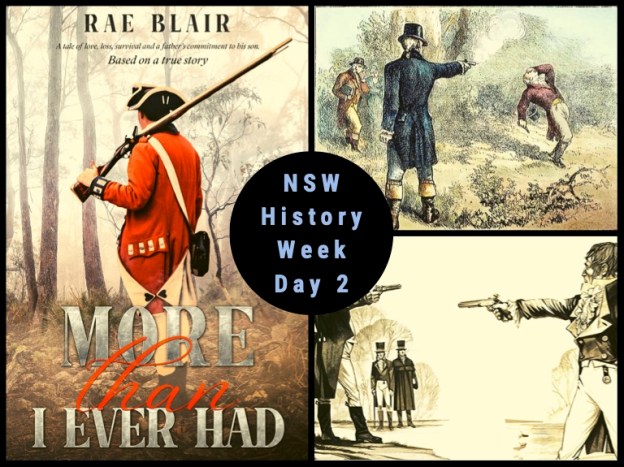
Duelling personalities: Part III
In support of NSW History Week 2022, here is part III of the second of five stories (presented in three parts) that formed the basis of my research for my novel More Than I Ever Had. This book is based on the true story of Theophilus Feutrill, who enlisted in the New South Wales Corps in 1789 in Birmingham.
Duel number three: Paterson v Macarthur 1801. Petty grievances
An article published in the Australian Star in September 1896, recounts a long-winded story about Sydney’s “first duel”*. It says “The whole affair is contained in the correspondence, official and private, and the tediousness is entirely due to the childish tetchiness, the elaborate slyness and the queer prolixity of many of the persons concerned. These were almost every individual of any station in the little community in the year 1801 of the occurrence.”
I’ll boil down the story as much as I can, but the whole issue begins with a drowning enroute to New South Wales. The drowned man’s effects were taken by the naval agent, Lieutenant Marshall, who replaced them with inferior products. Lieutenant John Macarthur—who was the temporary officer commanding the New South Wales Corps, in the absence of Colonel William Paterson—became aware of the swindle and took the matter up. The Governor severely reprimanded Lieutenant Marshall and sent him back to England on the next whaler. The article writes: “Marshall, resenting Macarthur’s action in the matter, thereupon found means to insult Captain Macarthur, who promptly sent Captain Abbott, of his corps, with a challenge. Lieutenant Marshall accepted.”
The problem was that Lieut. Marshall named a Mr Jefferies (purser of the Cornwallis) as his second. Macarthur was “up to his eyes in trade in spirits and every other commodity” so he ‘loftily objected’ and he would “by no means recognise (Jefferies) as second to his adversary.” Marshall duly attended the duel at the specified time and place, but Macarthur kept away. Enraged, Marshall “provided himself with a cudgel and went in search of (Macarthur).” Marshall found Captain Abbott in the doorway to Macarthur’s office, and he “dealt Captain Abbott a lusty thump on the ribs” then went in pursuit of Macarthur. When approached, Macarthur “(drew) his sword, (and) threatened to run the angry lieutenant through the body.” Marshall was arrested and taken to the guard-house.
Governor King then ordered that Lieut. Marshall should be tried by criminal court for assault against Abbott and Macarthur. By this time, Colonel Paterson had returned and “the court was property constituted with him, four other officers of the NSW Corps, Lieut. Grant and the Judge Advocate.” Whilst the case against Marshall for his “shady transaction with respect to the personal effects of the (drowned person)”, was straightforward, “Macarthur’s refusal to meet Lieut. Marshall in a duel appears to have been…impertinent, inasmuch as according to Governor King, he subsequently entertained at dinner at his own house, in company with Captain Abbott, the very man on whose selection as second to Lieutenant Marshall he alleged his disinclination to appear in the field.” Marshall “took objection to the constitution of the court” being made up of NSW Corpsmen, which was denied. Whilst Governor King did not intervene during the trial (Marshall was found guilty and sentenced to 12 months prison), he was provided with a record of the proceedings where there was “little doubt that the proceedings were conducted with distinct animus against the prisoner.” The Governor considered the appeal of the prisoner rested “on grounds solid enough to require serious attention. He instructed the court reconvene to investigate the allegations “not only to defend its own integrity, but to afford the most unequivocal justice to the prisoner…” The members of the court met, but refused to comply and “immediately dispersed.” The Governor said that he would “bring the business under the notice of the Secretary of State, and ask for support of his authority.” The five military members of the court wrote a letter asking for a copy of Marshall’s protest. The Governor refused, as the five military members were only a part of the seven member court. This pitted the five military members against the two others, and the officers “got savage and rather desperate. They agreed amongst themselves to cut the Governor socially. But this course proved too compromising (for) Colonel Paterson (who) quietly seceded. He resumed his ordinary relations with the Governor. Macarthur was furious.”
And this is where things become petty and dangerous.
Macarthur “threw the obligations of military discipline to the winds. He cast aside the obligations of a gentleman. He divulged private conversations with the colonel, he disclosed confidential communications. He stooped so low as to exhibit a private and familiar letter from Mrs Paterson to Mrs Macarthur. The fact was that the colonel had not been at all guarded in his demeanour and acts with relation to the Governor. He had criticised. He had sneered. He had even …(written)…to Sir Joseph Banks and General Brownrigg attacking the Governor’s public character and transactions. Macarthur had participated in these indiscretions. There are indications that he had instigated them. He now threw the burden of them on his colonel.” Colonel Paterson responded by doubling-down on his relationship with the Governor, and sent Macarthur a challenge.
The duel took place—Colonel Paterson chose Captain McKellar as his second, Macarthur chose Captain Piper. A scandal occurred when contrary to “all the proprieties” Macarthur was permitted to load his own pistols, rather than his second, which was the proper course of action. Macarthur asserted “there was something the matter with the locks (on his) pistols (and) it wasn’t safe for anyone unacquainted with their peculiarities to wad them…” Captain Piper, Macarthur’s second, won the toss for first shot.
The combatants stood at a distance and side-on, to make themselves as small a target as possible. Macarthur had first shot and “it took effect in the Colonel’s right shoulder. He was disabled and could not return the fire. A week later, his life was not out of danger. The Governor, of course, heard of the affair” and arrest warrants were issued to all those involved (except for the wounded man, Colonel Paterson).
The pettiness continued.
The Governor ordered Macarthur to Norfolk Island, but Macarthur refused to be released from prison. He demanded “reasons for being put under arrest…and for being ordered out of arrest.” Correspondence “hailed on everybody and from everybody, and a regular devil’s brew of cavils, assertions and explanations bubbled in a joint stock pot. Surgeons, adjutants, chaplain, judge advocate, surveyor, ensigns, lieutenants, captains, all had a finger in the mess. The Governor, while yet the pot was in full boil, got rid of Lieutenant Marshall…(by) shipping him off to be dealt with in England. As Macarthur positively would not be ordered out of arrest, he was got rid of in the same fashion, fighting tooth and nail to the last hour, and very nearly managing to bring about a small insurrection by treating his detachment of New South Wales Corps to a dinner and grog, such grog being removed from store without a permit, intercepted and seized by the officer of the guard, and all but violently rescued by the soldiery for whose benefit it had been intended.”
Whilst Macarthur was shipped off to England, he returned and was embroiled in the Rum Rebellion of 1808, but that, of course, is another story 😊
*Sydney’s first duel was, of course, between Captain William Hill and Major Robert Ross, fought on Sydney soil on 12 December 1791.
**
‘More Than I Ever Had’ based on the true story of Theophilus Feutrill is available from independent booksellers in Sydney and from Amazon. Link to Amazon Australia site here.
 Rae Blair