
Military mayhem in 1796
In support of NSW History Week 2022, here is the third of five stories that formed the basis of my research for my novel More Than I Ever Had. This book is based on the true story of Theophilus Feutrill, who enlisted in the New South Wales Corps in 1789 in Birmingham.
In February 1796, Theophilus Feutrill was one of four people whose name was on an arrest warrant issued by the Governor of New South Wales, John Hunter. If found guilty of the charges, the men named would be “obliged to answer for it, most probably with their lives.”
What were the circumstances that lead to this arrest warrant being issued? And, could Theo Feutrill, and the three other privates whose names were on the arrest warrants, really be the masterminds behind what happened, or where they just the scapegoats?
When John Hunter took over as Governor of New South Wales in September 1795, he knew he had a tough job ahead of him. The settlement was largely dependent on rum as currency and much at the mercy of the monopolistic trading practices of the military hierarchy and other officials. He complained in harsh terms to the Duke of Portland (one of the three Secretaries of State, who Hunter reported to) about the quality of the military members:
“…I should feel myself deficient in that duty which I owe to his Majesty’s service in this part of the world were I not to take a liberty which I have no reason to believe your Grace will be offended at—I mean, in remarking that the manner in which this corps has, since employed upon this service, been recruited does in a great measure weaken the effect or service which we would expect to derive from the assistance of the military. Soldiers from the Savoy,* and other characters who have been considered as disgraceful to every other regiment in his Majesty’s service, have been thought fit and proper recruits for the New South Wales Corps, which, in my humble opinion, my Lord, should have been composed of the very best and most orderly dispositions. They are sent here to guard and to keep in obedience to the laws, when force may be requisite, a set of the worst, the most atrocious characters that ever disgraced human nature; and yet we find amongst those safeguards men capable of corrupting the heart of the best disposed, and often superior in every species of infamy to the most expert in wickedness amongst the convicts. Our stores, provisions, and granaries must be intrusted (sic) to the care of those men: what security can we have in the hands of such people?”
*The Savoy was the name of the prison which housed military offenders.
At the time, Governor Hunter was approaching the age of sixty. Those who supported him were significantly younger: Captain Paterson, the commander of the Corps was forty; Captain John Macarthur, Inspector of Public Works, was twenty-eight. No others were older than Paterson. In the absence of a free press where independent commentary might have reached those back in London, the Duke of Portland relied not only on dispatches from Hunter, but he was also being petitioned by the likes of the ambitious John Macarthur, who held little back in his criticisms of the administration.
Governor Hunter’s leadership was tested following an event which occurred on 5 February 1796, and is considered to be the catalyst for the Duke of Portland to eventually recall him to England and replace him as Governor. In a letter from Governor Hunter to the Duke of Portland dated 10 August 1796 (which was not acknowledged by Portland until more than a year later on 31 August 1797), Hunter outlines an event which he describes as an ‘outrage’. An abridged version of his report is below:
“Statement of the Case of John Baughan.
John Baughan…foreman of the carpenters working at Sydney, and a private soldier of the New South Wales Corps, (also a carpenter), had some dispute when formerly working together… This dispute, it appeared, had not subsided in the min of the soldier, and was probably not wholly forgot by the other.
…One day when sentinel over a storehouse, knowing that Baughan was at work in a house some distance from his post, (the Private) set his arms down against the wall of the store, and seeing a man whom he knew standing on the outside of the building in which Baughan was at work, entered into a conversation with him, of which Baughan was the subject, and which much abuse was bestowed, (and)… meant for Baughan (to) (over)hear.
Baughan went out at the back door unperceived, and seeing the soldier without his arms, went to his post, where he found the musquet, which he took up and carried to the guard-house, and delivered to the Serjeant (sic) of the guard. The soldier was, of course, taken notice of and relieved, being without his arms.
The next day, 5th February, at half-past nine o’clock in the forenoon, the whole of the corps off duty at this place assembled, and in the most public and tumultuous manner proceeded to the dwelling of John Baughan, broke open his gates, doors, and windows, entered his house, chopped the corner-posts of it, broke his bedsteads and bedding, chairs, window-frames, drawers, chests, and, in short, completely demolished everything within his possession to a considerable amount, for the man had, by great labour and industry, built himself a neat house, and had it well furnished.
Upon their first approach, having had a few minutes’ notice, he armed himself with a loaded gun and defended himself by threats for some time, but their numbers were so many that they surrounded his paling which inclosed (sic) the house, which some tore down and entered on the opposite side to that which he endeavoured to defend, came behind him, secured and threw him down, with his face to the ground, whilst one held an axe over his neck, and swore if he offered to stir he would chop the head from his body. During the time he remained in this situation they completed the ruin of his whole property, to the very great terror of the man’s wife, after which they went off cheering, as if something meritorious had been effected, and marched in a body cross the parade before their commanding officer’s house.
After so daring an attack, in the open day, upon the dwelling-house of an inhabitant, and in direct defiance of all law, civil or military, they could only be considered as in a state of mutiny. I immediately issued in Public Orders the paper No. 2.”
Public Orders Paper #2 is reproduced below:
Government and General Order. 5th February, 1796.
“The very riotous manner in which the soldiers have conducted themselves this morning, and the very unwarrantable liberty they have thought proper to take in destroying the dwelling-house of John Baughan, is so flagrant a crime against the laws established in this colony that nothing but the want of proof to substantiate who the principal actors in this disgraceful business were could possibly prevent their being immediately tried for so glaring an offence against the peace of the colony.
The Governor thinks it necessary to assure the soldiers that he considers their conduct upon this occasion to have been disgraceful to the character of a British soldier, and that he did hope to have found men amongst them who would have had pride enough to have stood forward and pointed out the ringleaders of so mutinous a conduct, for in no other light can it be considered than that of mutiny when the military assemble in such numbers unknown to their officers, who are at all times ready to listen to any complaints they may have to make, and to see that agreeable to common justice they are redressed. If the soldiers expect that the Governor or any of the officers in this settlement can hereafter consider them as…meriting the honorable appellation of British troops, it must be by their bringing forward the ringleaders or advisers of this disgraceful conduct, in order that the stigma may be wiped away by such worthless characters being brought to trial for this shameful conduct.”
The reception of the Public Orders and mood of the soldiers is indicated by Governor Hunter in his letter to the Duke of Portland:
“But as an alteration in the ration had at that very time been ordered, I think it necessary to observe that their temper at the moment was so violent that they positively refused to take it unless they were served all flour, instead of part flour and part corn, a desire which could not be complied with without manifest injustice to others, and also insisted upon being paid short-allowance money for the time they were on short ration, which they say Governor Phillip had promised them. This last demand I must request your Grace’s instructions upon.”
Governor Hunter met with the commander of the Corps, Captain William Paterson on 6 February and wrote to him the next day advising his change of heart (wisely) in wanting to address the soldiers directly. He couched his decision that to address them directly “would be a condescention on my part which their violent and unsoldierlike conduct does not entitle them to from me.” He goes on to say to Paterson:
“I must declare to you, sir, that the conduct of this part of the New South Wales Corps has been,…the most violent and outrageous that was ever heard of by any British regiment whatever, and I shall consider every step they may go father in aggravation as rebellion against his Majesty’s government and authority, of which the most early notice shall be taken, and those concerned be in due time obliged to answer for it, probably with their lives.”
As previously mentioned, the Duke of Portland did not respond to Governor Hunter on this matter for more than a year, leaving the governor to deal with this without his support. The governor did, however, have the support of Doctor William Balmain who (without legal training) held the position of Judge-Advocate. From the military side, Captain John Macarthur represented the interests of the NSW Corps.
After the attack on his home, John Baughan, fearing further retribution, declined to identify those involved or to pursue the matter. Dr Balmain ‘proffered’ legal advice (some historians considered Balmain threatened Baughan with obstruction of justice should he not progress the matter ). After some days, four names were eventually given up. When the governor issued the arrest warrants, the military was further enraged at Balmain’s “shamefully malevolent interference in the affairs of the Corps”. One of the warrants was for the arrest of Theophilus Feutrill.
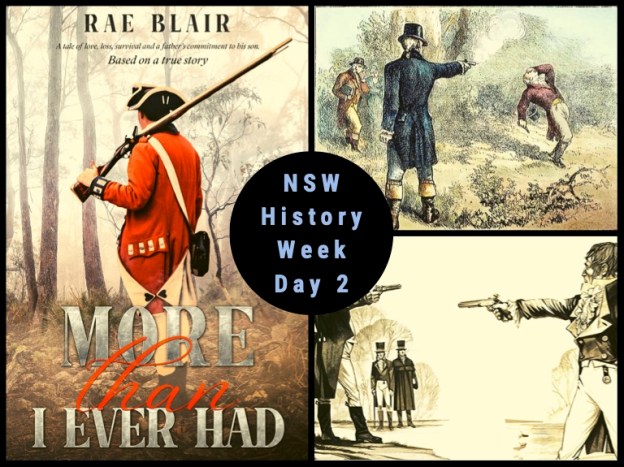
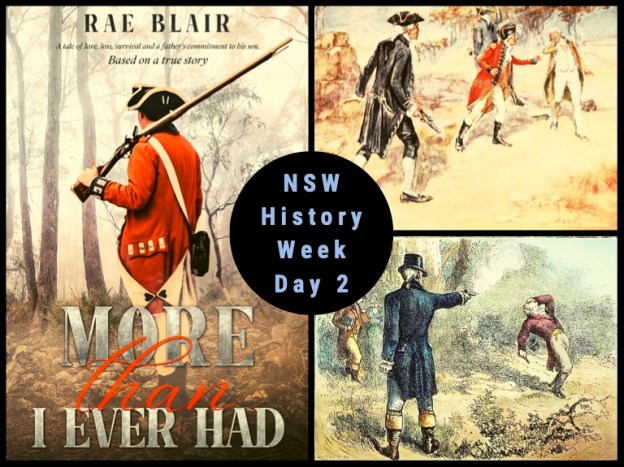
As the military were responsible for enacting the arrest warrants, Captain John Macarthur approached the governor and stalled the process. Thus began a test of strength between the civil and military authorities. As Theophilus fretted over his fate—he was facing potential execution if found guilty—a series of letters was exchanged between Judge Advocate Balmain (representing the civil authority) and Captain John Macarthur (representing the military). Tempers frayed and insults given to the point that Balmain told Macarthur he was “a base rascal and an atrocious liar and villain”. Balmain then challenged Macarthur to a duel, which was subsequently withdrawn.
Captain Macarthur approached the Governor in the name of the Corps and was “expressive of their contrition, their sincere concern for what had happened, promising at the same time that they would endeavour by their future conduct to wipe away the odium which this recent instance of disorder and want of respect for the laws, the peace, and order of the settlement had brought upon them; they also agreed to indemnify the sufferer for his loss.” Upon receiving this message from Macarthur, and by the personal petition of the sufferer, John Baughan, the governor ordered the warrants to be withdrawn as “the consequences would otherwise most probably have been fatal to some.”
Peace was restored, but the Duke of Portland saw Hunter’s capitulation as weakness in his leadership.
John Hunter was recalled to London in a stern dispatch from Portland dated 5 November 1799. The withdrawal was acknowledged by Hunter on 20 April 1800, and he handed over the government to Lieutenant-Governor King on 28 September.
Why was Theophilus Feutrill’s name included on the arrest warrant? The Governor wanted the members of the military to come forward and give up the names of the ring leaders. But it appears unlikely that a private soldier would have the compelling presence or authority to whip up “all off-duty military members” to such an action. Was he, and the other privates listed just scapegoats, or were they more involved? The records are silent, but it is easy to imagine the relief he and his wife Ann would have felt upon hearing the warrants were withdrawn.
**
‘More Than I Ever Had’, based on the true story of Theophilus Feutrill, is available from independent booksellers in Sydney and Amazon.
 Rae Blair