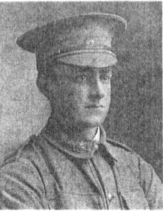
When Clara Hamilton Kaufmann was born in Victoria in 1867, her immigrant parents were so connected to their home in Australia that they used the place of her birth as her middle name.
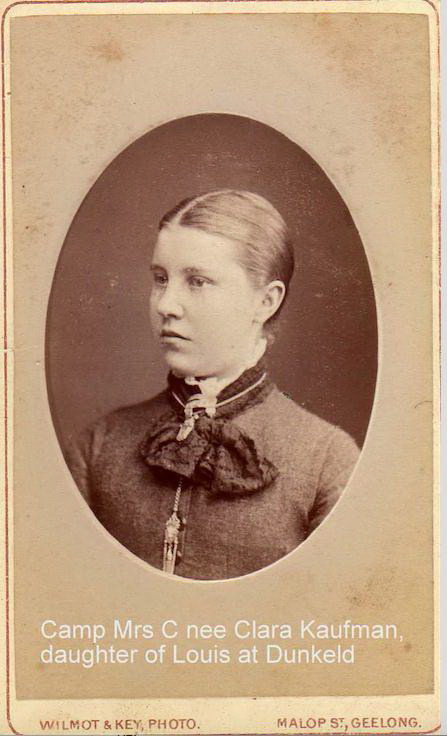
Her father, Louis Kaufmann, was born in Hanover, Germany, and left his homeland when he was twenty in 1857. He first moved to England and emigrated to Australia a few years later. Here, he married Susannah Thomas, a woman of Welsh heritage, and they had four children together. On 20 March 1865, at age twenty-eight, Louis became a naturalised citizen of Australia. In the sixty-odd years before his death in Australia, Louis served his community as a Justice of the Peace and Councillor of the Mount Rouse Council for twenty years; he ran a butchery; built a very successful wool buying and exporting business, with his product receiving top dollar in London; owned significant land holdings in the Dunkeld area; sponsored prizes at local fairs; and was responsible for introducing localised refrigeration for storage of meat products.

On 25 April 1885, an article appeared in the Australasian supplement by a journalist who visited Dunkeld. He spent some time with Louis, and his impression was as follows: “Mr Louis Kaufmann, wool buyer and scourer, a German gentleman long settled here, as true an Australian as you will find anywhere. He is sound on all national questions. I gladly welcome such citizens who come out of the bondage of Bismarck to help forward the Australian race.”
But not everyone was fully accepting of Australia’s immigrants from Germany, especially once Australia was at war. On 18 August 1916 (two years into WWI), Louis’ name appeared in a newspaper article titled Eliminating the Alien—which asked local councils to ‘urge the State government to take action to disqualify Germans from holding seats as councillors or justices of the peace.’ Louis’ name appeared in a list of all German-born people who served on local councils. Louis retired from council on his own terms, and was the subject of further racism during this time, but it’s hard to imagine the impact Australia going to war against the Germans would have had on him and his family.
Clara was Louis’ second of three daughters (plus there was a son). She married Charles Camp in 1891, the son of a successful carriage builder in Geelong, when she was twenty-four and together they had two children: a son, Cyril Kaufmann Camp in 1892 and a daughter, Dorothea Claire Kaufmann Camp in 1894.
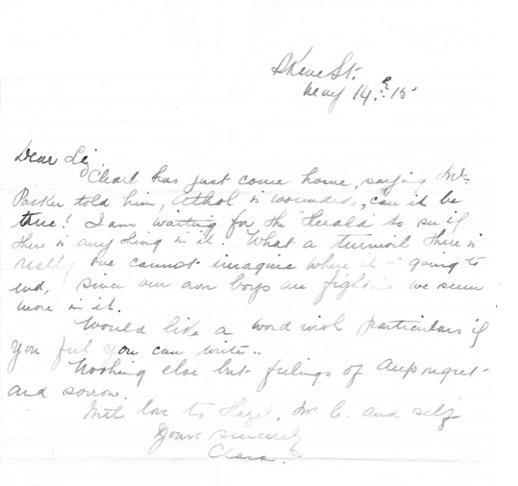
Australia became involved in the First World War on 4 August 1914. Clara wrote to a friend—one mother to another—on 14 May 1915, expressing her fears and ‘deep regret and sorrow’ at hearing that her friend’s son had been wounded. Three months later, exactly one year to the day Australia joined WWI, Clara’s own son would enlist—to fight her father’s homeland.
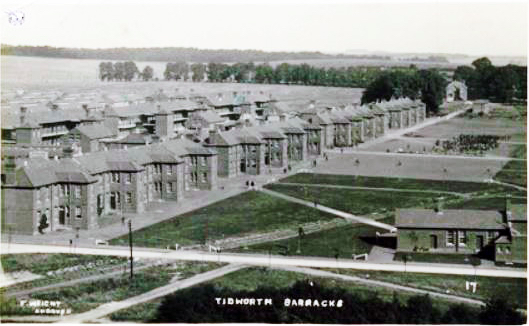
Cyril was allocated to the 24th Battalion (11th Reinforcement) and proceeded to England where he undertook the ‘First Rifle Course’ held at the School of Musketry, Tidworth from 18 July to 9 August 1916.
He then travelled to France on 16 September 1916. The following month, while serving in Belgium, he was promoted to Acting Sergeant, then to Lance Corporal a month later, then promoted during battle to Temporary Corporal on 11 November 1916 in France. Two days later, on the battlefields of the Somme, Cyril’s war would be over.
From Museums Victoria: ‘Tanks wallowed about in the mud, pack horses and mules laden with shells trailed across the fields, and the guns boomed and flashed all night.’ Sergeant W.J. Harvey, 24th Battalion AIF, November 1916.
The lead-up to winter in the autumn of October – November 1916 in the battlefields and trenches around the Somme was one of the worst times of the war for Victoria’s 24th Battalion, AIF. Along with Australia’s other military units, the Battalion’s situation on the Western Front changed dramatically, from bad to worse. The cold and increasingly muddy conditions added to the chaos and hardship of army life, for an already exhausted group of men.
The 24th Battalion was raised in Victoria, Australia, and formed a quarter of the 6th Brigade. Three brigades formed a division, and as part of the 2nd Division the 24th Battalion fought in Australia’s major engagements of the Somme Offensive. Their losses were particularly high in ferocious engagements at Pozières and Mouquet Farm, where the 2nd Division suffered 6,848 casualties in just over a week of fighting. While the territory around Pozières and Mouquet Farm was considered strategically essential, the battles were hard-won. Given the catastrophic losses of life, the number of wounded and missing, and the years of ongoing strain to the living, some would argue that there were no winners in this chapter of World War I.
Below is a photograph taken by Lieut. John Warwick Brooke at the Somme on 13 November 1916–the day Cyril was killed. In it, a soldier is showing his damaged helmet to another, after receiving treatment for his wounds. These were the lucky ones that day. (Image from the Ministry of Information First World War Official Collection)

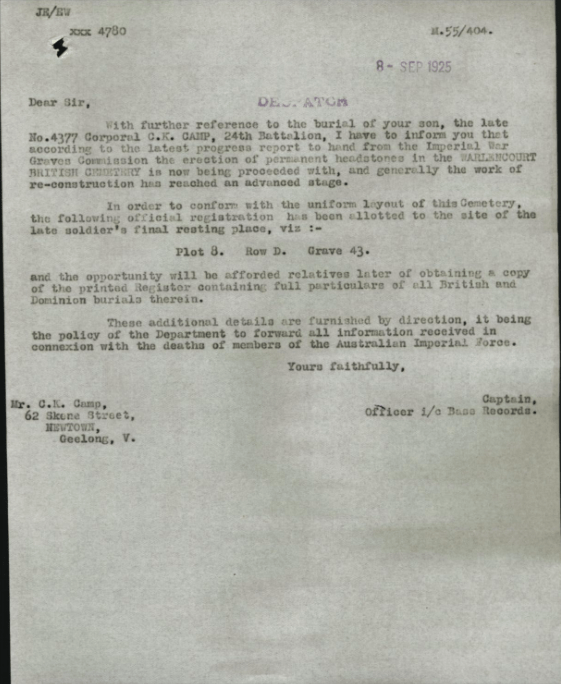
Cyril was buried at the Warlencourt British Cemetery as detailed in a letter dated 8 September 1925 to his father, Charles Camp (nine long years after Cyril’s death).
Or was he? It is unclear whether the below document pre- or post-dated the letter regarding the Warlencourt British Cemetery burial. However, it is specific in stating that “this man [Cyril Camp] is not buried in Warlencourt New British Military Cemetery”, rather he is buried amongst “isolated graves about 3.5 miles S.W. of Bapaume”. Although, in another record, a photograph of his grave was sent to his next of kin on 16 July 1920 (a copy of the photograph isn’t included in Cyril’s service file). Perhaps it was a photograph of his ‘isolated grave’ and he was re-buried five years later to Warlencourt?

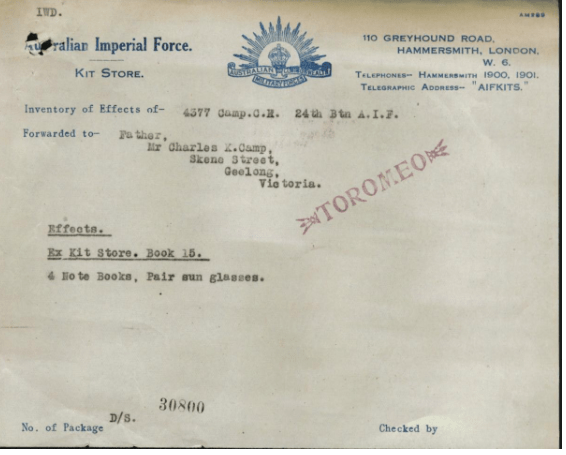
Cyril’s mother, Clara, wrote to the Army in August 1917, then his father, Charles, wrote a month later, seeking “some word about his personal effects which would be upon him when he fell in November last.” Cyril’s very few remaining effects were eventually shipped to Australia via the SS Toromeo and returned to his father. His very few effects makes for sad reading.
Cyril was a month shy of his twenty-fourth birthday when he was killed. As a child, he attended Geelong Grammar School and participated in the Cadet program for six years. Upon leaving school, he became an accountant by trade and worked with the Bank of Victoria before he enlisted in the AIF. He never married. It is difficult to imagine the pain of loss suffered by his family, and perhaps even more so, given he was killed by his grandfather’s former countrymen. His grandfather, Louis, died five years later perhaps never knowing where his grandson was buried. His father lived another nineteen years, his mother a further thirty-four—a heavy burden to carry over such a long time.
Cyril and a few other fallen soldiers were remembered in a memoriam placed in the Argus on 8 November 1917. It concluded with:
Soldiers yes, and heroes too
They have played a man’s part, through and through
Their actions speak, though their voices are still
Forget them; no, we never will.
 Rae Blair