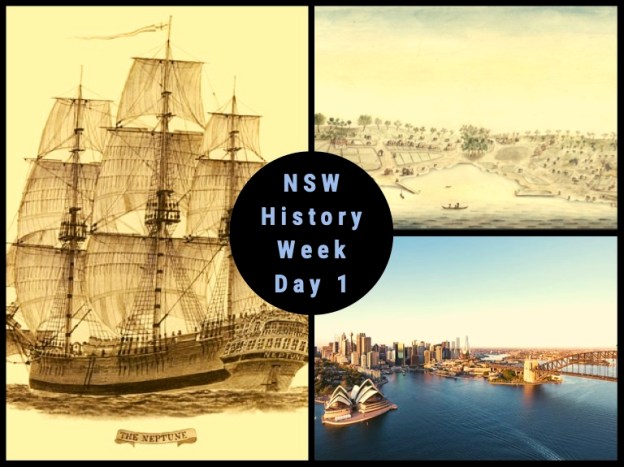
The Arrival of the Second Fleet
In support of NSW History Week 2022, I will share five stories that formed the basis of my research for my novel More Than I Ever Had. This book is based on the true story of Theophilus Feutrill, who enlisted in the New South Wales Corps in 1789 in Birmingham.
British settlement of Sydney Cove was eighteen months old, when Private Theo Feutrill, member of the newly formed New South Wales Corps, arrived in Port Jackson on the Neptune as part of the Second Fleet. At the time, Sydney Cove had a settler population of just over 1,000 people (including 736 convicts). When the six ships of the Second Fleet arrived in June 1790, the passengers (including the military and convicts) more than doubled the population number.
But before Theo arrived on the Neptune, the settlers, which arrived in 1788 (eighteen months earlier) had long been expecting to receive supplies from Great Britain. A great deal of frustration and anxiety was felt in the growing absence of ships, as supplies dwindled and precious food rations were reduced. Upon sighting the first ship to arrive since the First Fleet, on 3 June 1790, Lieutenant-Colonel David Collins wrote it was “to the inexpressible satisfaction of every heart in the settlement (that) the long-looked-for signal was made for a ship at the South Head. Every countenance was instantly cheered, and wore the lively expressions of eagerness, joy and anxiety.”
Captain Watkin Tench went a bit further in his journal: “At length the clouds of misfortune began to separate, and on the evening of the 3rd of June, the joyful cry of “the flag’s up,” resounded in every direction. I was sitting in my hut, musing on our fate, when a confused clamour in the street drew my attention. I opened my door, and saw several women with children in their arms running to and fro with distracted looks, congratulating each other, and kissing their infants with the most passionate and extravagant marks of fondness. I needed no more; but instantly started out, and ran to a hill, where, by the assistance of a pocket glass, my hopes were realized. My next door neighbour, a brother-officer, was with me; but we could not speak; we wrung each other by the hand, with eyes and hearts overflowing.”
Their joy was to be short-lived, however, to be replaced with “wonder and mortification” that the ship they saw (the Lady Juliana) contained not livestock and supplies as they had been expecting, but female convicts. The colonists soon learnt the sorry tale that a supply ship had been sent earlier, but had struck an iceberg just off the coast of South Africa. Three days after the sighting of the Lady Juliana near South Head in New South Wales, the passengers disembarked and it was “a little mortifying to find on board the first ship that arrived, a cargo so unnecessary and unprofitable as two hundred and twenty-two females, instead of a cargo of provisions.” When the women landed “many of them appeared to be loaded with the infirmities incident to old age, and to be very improper subjects for any of the purposes of an infant colony.” And “instead of being capable of labour” they appeared to be “never likely to be any other than a burthen to the settlement.”
However, the situation appeared to improve somewhat on the 20th when, at last, a storeship came in sight. The Justinian was the second ship in the Second Fleet to arrive, and it was greeted with great joy, but this welcome news was tempered as the colonists learnt “that three transports might be hourly expected, having on board (one) thousand convicts …. together with detachments of a corps raised for the service of this country.”
After the Justinian arrived, the full food ration was reinstated to be “issued weekly”, and “the drum for labour was to beat as usual in the afternoons at one o’clock.” With replenished stores, Lt.-Col. David Collins wrote: “How general was the wish that no future necessity might ever occasion another reduction of the ration, or an alteration in the labour of the people.” With our telescope looking back through the years, knowing what is ahead for these people, we realise it is a futile wish.
Nearly three weeks later, the transport ships Surpize, Neptune (with Theo Feutrill onboard) and Scarborough arrived and from that point onward, the Second Fleet was to be forever known as the worst fleet ever to arrive in Australia—and the Neptune was regarded as the worst ship of them all. As the colonists gathered to watch passengers and convicts disembarking they were in a for a shock. Lt.-Col. David Collins wrote that two hundred people arrived sick, but Capt. Watkin Tench had the number closer to five hundred. As the condition of the passengers and convicts became obvious, Lt.-Col. David Collins wrote “the west side (of Sydney Cove) afforded a scene truly distressing and miserable; upwards of thirty tents were pitched in front of the hospital (the portable one not being yet put up); all of which, as well as the adjacent huts, were filled with people, many of whom were labouring under the complicated diseases of scurvy and the dysentery, and others in the last stage of either of those terrible disorders, or yielding to the attacks of an infectious fever.”
As months passed, the devasting numbers of deaths became known. History records show if you measure passenger survival of those who sailed on the Second Fleet from the time they left England and to within eight months of arrival in Sydney, the convict mortality rate was around a shocking 40 per cent. Much outrage was expressed to the Home Secretary back in Great Britain, and contracts for convict transportation were immediately changed. The story of the Second Fleet is the subject of my blog The Scandal of the Second Fleet, which can be found on my website.
Despite the horrors passengers and convicts experienced sailing to New Holland on the Neptune, the landing of this notorious ship in Sydney Cove on 28 June 1790, began Private Theo Feutrill’s association with the land to become known as Australia. His efforts, and those who came out on the First, Second and subsequent fleets, forged a country which has been home to at least eight generations of his family.
The novel, based on Theo Feutrill’s life called More Than I Ever Had, is available from independent booksellers in Sydney and also from Amazon (link to Amazon Australia site here.)
 Rae Blair