
If this is the first of my posts you are reading, then I suggest you go back to Part I and read the posts in sequence.
A major roadblock stood in the way of my identifying the parents of my 2x Great-Grandfather, John Willington Jackson. I had his government-issued death certificate, which listed his parents as John Jackson and Elizabeth Willington. But a tip from a member of the Ancestry.com community pointed me to the Will* of an Irishman called William Jackson, whose son was John Willington Jackson (living in Melbourne, where my John Willington Jackson lived).
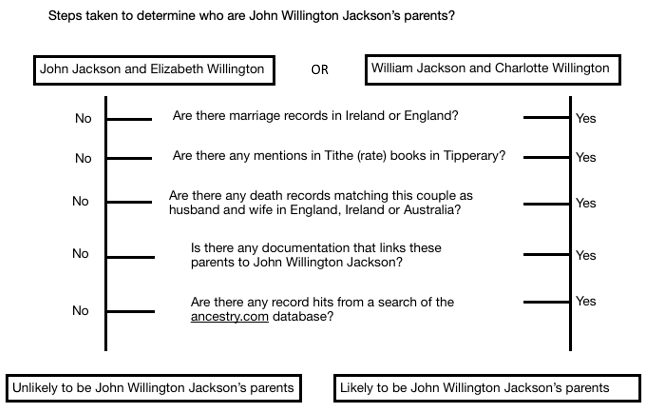
This set in motion many weeks of research to uncover who were the parents of my 2x Great-Grandfather. I couldn’t accept any of the information on face value. I needed supported facts as I didn’t want future hours of work built upon incorrect information. Below are two flow charts which summarise how I determined the true identity of John Willington Jackson’s parents. The flow charts are followed by dot points giving specific details of the research undertaken. I also consider the possibility of whether there might have been two men called John Willington Jackson, and what I do next.
Why would the information on John Willington Jackson’s death certificate be wrong?
Was it because the person who provided it didn’t know the information / or didn’t care if the information was correct?
We know he was living with his daughter, Elizabeth, and son-in-law, (Charles) Henry Marlow at the time of his death, so it is logical to assume it was either Elizabeth or Henry who provided the information. By determining who provided the information for the death certificate, we might be able to gain some insight as to why the information was wrong.
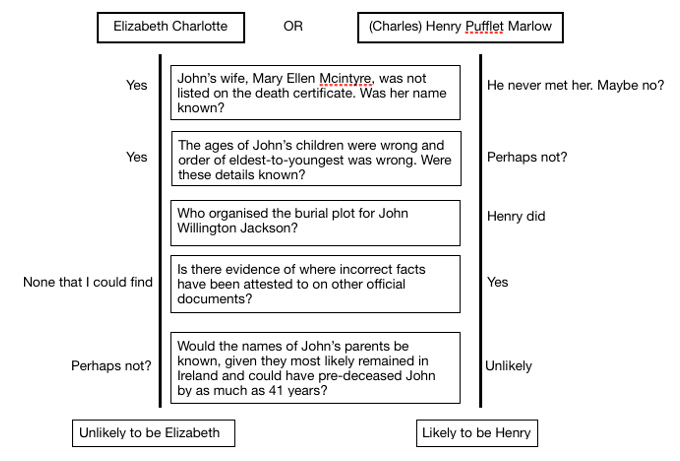
So, I am of the opinion that John Willington Jackson’s son-in-law provided the information for the death certificate and the information he provided was assumed and wrong. I’m also of the opinion that John Willington Jackson’s parents are William and Charlotte Jackson of Tipperary. Below are the specific steps I took to support my assumptions.
(1) Are John and Elizabeth (Willington) Jackson the parents?
1.1 Through a manual search of Irish and English records, I could not locate a John Jackson (born around 1800) marrying an Elizabeth Willington. There were plenty of men called John Jackson born around that time who married an Elizabeth, but none of these women were from the Willington family. I also found Elizabeth Willingtons in England, but none in Ireland.
1.2 I could not locate any death records for a John Jackson who was the husband of Elizabeth Willington, and vice versa, in England, Ireland or Australia.
1.3 John Willington Jackson’s occupation was an engineer. His occupation would have been the result of an excellent education, provided by a family with resources. Families with resources either owned or rented land for farming, and their details appeared in Tithe books. The name of John Jackson (Snr) doesn’t appear in the Tithe books.
1.4 I entered the names of John Jackson and Elizabeth Willington as John Willington Jackson’s parents into my Ancestry.com family tree. This data combination of parents and child did not return any records from the automatic cross-reference of the Ancestry.com databases.
(2) Establishing the source of John Willington Jackson’s death certificate information.
2.1 Census records show John Willington Jackson was living with his eldest daughter and husband in 1903—occupation listed as ‘Engineer’. The occupation detail aligns with information recorded on his son’s death certificate (William). If John was living with his daughter and son-in-law at the time of his death, then it is logical to assume that one of them provided the death certificate information, as his other children remained living in Victoria.
2.2 Karrakatta Cemetery in Perth is John Willington Jackson’s place of burial. Upon obtaining a copy of his burial record from the cemetery, I found this was arranged by his son-in-law, Charles Henry Pufflett Marlow—known as Henry. Therefore, it is probable that Henry took care of all the paperwork relating to John Willington Jackson’s death.
2.3 The name of John’s wife, Mary Ellen Mcintyre, is not recorded on his death certificate. If John’s daughter, Elizabeth, provided the information, this detail would have been included. This leads me to assume that Henry provided the information. (note: Elizabeth’s mother died three years before she married Henry Marlow.)
2.4 The ages of John’s children were recorded incorrectly on the death certificate, as was their age order. If John’s daughter, Elizabeth, provided the information, this detail would have been accurate. That the information was wrong, adds weight to my assumption that Henry completed the death certificate.
Why would Henry think John Willington Jackson’s parents were John and Elizabeth?
2.5 When John Willington Jackson died, he had been in Australia at least 51 years (based on the date of birth of his eldest child born in Australia; and the now unreliable death certificate information which indicates he had been in Australia for 56 years at the time of his death). No matter who were John’s parents, they would have been deceased by the time of John’s death. If William (for example) was John’s father, he would have pre-deceased John by 41 years: a long time for family connections to be lost. The loss of family history information is further compounded because John’s wife (Mary Ellen Mcintyre) had pre-deceased him by 30 years.
2.6 Let’s just suppose that Henry didn’t know who John’s parents were. He might have assumed that they named John after his father, and then John named his first born after his mother (hence John and Elizabeth fits as the parents). Unusually, the death certificate does not record middle names for the parents.
2.7 In delving deeper into Henry Marlow, I discovered an enlistment application for the Australian Imperial Force dated 19 March 1917 for Charles Henry Marlow. The address, occupation and next of kin (“Sharlot Elizabeth Marlow”) confirm this is an application for ‘my’ Henry Marlow. But there are errors on the attestation document: i) it lists his age as 49 years (when he was 57—too old to enlist); and ii) his wife’s name is misspelled. Henry was promoted to the rank of Sapper and assigned to the Tunnellers. Whether he confessed after facing the work in the tunnels, or was discovered, the army discharged him for “being over age” after 11 weeks’ service and for “making a false answer on the attestation document.” This is evidence that Henry was not respectful of facts on official documents.
All the above increased my doubt that John Jackson and Elizabeth Willington were the parents of John Willington Jackson.
(3) Are William Jackson and Charlotte Willington his parents?
3.1 According to the Ireland Civil Registration Deaths Index, William was about 69 when he died, meaning he was born about 1798. This makes him age-appropriate to be John Willington Jackson’s father (that is, he would have been around 31 when his son was born).
3.2 I discovered documents confirming that William lived all of his life in Tipperary and died in Nenagh, in the county of Tipperary as a farmer. He lived in a home called Camira; a residence befitting people with some status. John Willington Jackson was born in Tipperary.
3.3 William’s Will, dated 2 February 1866, includes the following extract:
“The interest accruing yearly upon said principal sum to be paid to my kind and affectionate sister-in-law Eliza Willington…… and at her demise to my son John Willington Jackson all principal sum or sums now suppose to be residing in Melbourne, from where his last letters home bore date.”
My 2x Great-Grandfather, John Willington Jackson, was living in Melbourne in 1866.
3.4 The St Mary’s Parish Church of Ireland records contain the marriage details of William Jackson and Charlotte Willington dated 30 January 1826. Charlotte had a sister called Eliza. William’s brother, Minchin, witnessed the marriage and his address is Usher’s Quay Dublin. Minchin would have been 16 at the time of the marriage and most likely boarding at the academy or boarding school at 28 Usher’s Quay.
3.5 William’s name, the names of his father and brother, and the name of his wife’s family, all appear in the Tipperary Tithe books as owners or renters of land. William had the resources to give his son an excellent education, leading to John Willington Jackson’s occupation as an engineer.
3.6 Let’s now consider John Willington Jackson’s name, and those of his children, and assume that William is his father.
– William was the second-born son of George Jackson (1761-1823).
William’s brother (the first-born son) was called George II (1786-1862).
George II named his first-born son George III (1820-1834), so by the time John Willington Jackson was born, he already had a cousin called George Jackson.
However, Charlotte Willington’s father was called John Willington (1755-1819). So John Willington Jackson is most likely named after Charlotte’s father (his grandfather).
– John Willington Jackson’s first-born son was called William John Jackson (1863-1942). William John Jackson is most likely named after his father, and both grandfathers.
– John Willington Jackson’s eldest child was called Elizabeth Charlotte Jackson (1857-1935), but went by the name Charlotte, according to the name on her burial headstone. She is most likely named after John’s mother (and perhaps a nod also to Charlotte’s sister, Eliza).
(4) Could there be two John Willington Jacksons?
I cannot find records in Australia of two men called John Willington Jackson.
However, if John and Elizabeth (Willington) Jackson were the parents of John Willington Jackson, then we have to accept that there were two John Willington Jacksons. Two men, with the same names, who were born around the same time in Tipperary Ireland. One to John and Elizabeth (Willington) Jackson (people whom I can’t identify), and the other to William and Charlotte (Willington) Jackson (of whom records exist).
Also, we’d have to accept that both men, named the same, made the unusual decision to emigrate to Melbourne Australia (when so many people from Tipperary at the time emigrated to Canada and the US).
Academics# have noted that “While the destruction of records makes it impossible to trace each family back to its first appearance in North Tipperary…. it is certain that in many instances the bearers of a common surname must also share a common ancestor. This conclusion is supported by the manner in which many surnames localized within the region in the early nineteenth century.” This says that it is unlikely there were two separate Jackson and two separate Willington families in Tipperary around that time.
(5) A possible reason why John Jackson would chose Australia?
With the assumption that William and Charlotte are the parents: I discovered that John Willington Jackson’s first cousin, James Willington, emigrated to New South Wales between his marriage in England in April 1853 and the birth of his son in Sydney in January 1854. So there was at least one reason John Willington Jackson would come to Australia.
Based on the research, I cannot accept there were two John Willington Jacksons. All of the research points to the death certificate containing incorrect details, and that his parents were in fact William Jackson and Charlotte Willington.
Satisfied with my conclusion, I could now proceed to research the Jackson and Willington families in Tipperary—but I was tantalised by William Jackson’s reference in his Will to his ‘kind and affectionate sister-in-law Eliza Willington.’ What was that all about?
Next time, I go to Ireland!
*If you are fortunate, you can access your Irish ancestor’s Will via the Irish National Archives site.
#Elliott, B.S. (1987) Irish Migrants in the Canadas. McGill-Queen’s Press.
 Rae Blair